# 75 - Voice Writing vs. Steno with Rachel: Translation Friction, AI & Standards
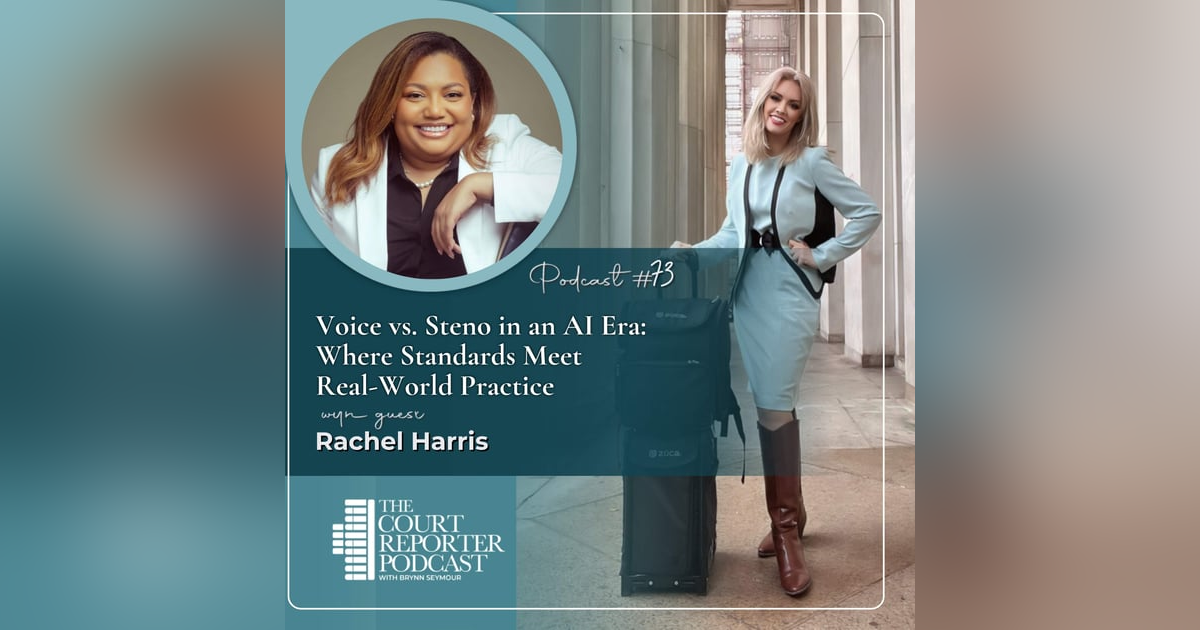


Brynn Reynolds Seymour and Rachel Harris follow the fault lines: a near-split vote, frustrated translation rates, and tools that promise more than they deliver. What happens when mask tech, software shifts, and courtroom culture collide—and the record still has to be right? Step inside the tension to hear where standards hold, where they bend, and what seasoned reporters are watching next.
Guest Bio
Rachel Harris is a court-reporting consultant to the Lagos judiciary, where she’s building standards, training judges on effective reporter utilization, and leading projects to retrain voice writers to stenography. A longtime scoping coach, she bridges real courtroom workflows with practical training, helping reporters translate tech into clean, certifiable records.
⭐ Leave Us a Review!
Enjoyed the episode? Drop a 5-star rating or a quick line about your takeaway—those signals help more reporters and attorneys find the show. Thanks for listening and for supporting the podcast.
Welcome to the Court Reporter Podcast, the space where court reporters are seen, heard, understood and supported.
Speaker AI'm your host, Bryn Reynolds Seymour, certified life coach and proud to be celebrating 10 years as a court reporter in 2025.
Speaker AThis show is here to help you unlock your full potential, achieve the big goals you keep putting off, and step fully into the leader you were meant to become.
Speaker ALet's get into it.
Speaker AHi Rachel.
Speaker AWelcome back to the Court Reporter Podcast.
Speaker BThank you, thank you.
Speaker ASo we had this great idea just to have a conversation about, like, what's going on in the industry.
Speaker ASo tell me what you came up with.
Speaker BOkay, so one thing that I'm always interested in is the blogs that I get from Steno Anonymous and kind of seeing like how they might tally with what I'm seeing in space, like different Facebook groups and things like that.
Speaker BSo his information, I really think it's interesting how the group circle, like we have the opinions around NCRA and NVRA and whether voice can come into those conversations.
Speaker BAnd one thing that I've noticed in the voice groups that I've been seeing is how there's this, I don't want to say confusion, but maybe like conversation around them using AI tools when their translation rate is not what they want it to be.
Speaker BAnd really how frustrated a lot of voice writers are.
Speaker BI don't know how many numbers, but with their editing times and of course I can see that as a scopist, when I work with voice writers, their translation rate, it's the average voice writer is not getting the translation rate that a steno would get.
Speaker BSo that's something that's interesting to me because on the one hand, voice is celebrated and is better, quote unquote than digital or AI or those types of things.
Speaker BBut when you, when I talk to or not even talk to, just hear from like reading their posts in different groups, they're really frustrated with their translation rates and their and like the process.
Speaker BI know there's other softwares out there that you know are supposed like assist or one is better than the other.
Speaker BBut I think generally I see more frustrated voice writers then I see frustrated.
Speaker BAnd that was something that was just interesting to me.
Speaker BSo that was a little tidbit that I came across and I was seeing a lot of discourse about it in the different Facebook groups.
Speaker BAnd of course the conversation around voice writers, you know, that that poll or that vote was done for NCRA of whether they were going to be able to be a part of the membership or not.
Speaker BAnd so yeah, that was my what I Stumbled across and okay, so there.
Speaker AWas a poll that the NCRA did about whether voice writers should be accepted as members.
Speaker AAnd what was.
Speaker ADo you know what the result was of that poll?
Speaker BThey were not going to be allowed in.
Speaker AOkay, yeah.
Speaker ADo you know what the numbers were or.
Speaker ANo.
Speaker BLet me see if I can scroll through their page really quick.
Speaker AThe NCRA page?
Speaker BYeah, the Facebook one.
Speaker BTo see.
Speaker AOh, they published like, oh, so they just put a poll on Facebook and then everyone was just.
Speaker BWell, I can't.
Speaker BI don't know how they did the poll, but I remember while I was at NC cra the results came out that they weren't going to allow it.
Speaker BSo there was like a vote by the members, I think.
Speaker AWas that this year or last year?
Speaker BThis year.
Speaker BThis year.
Speaker BI'm actually scrolling through their Facebook page now.
Speaker BAnd so that conversation was kind of being had and I just found it interesting because.
Speaker BAnd I don't have a ton of facts or a ton of information about this, but what I found interesting is that if generally I just wondered like, who were the people, I guess, that wanted to be a part of.
Speaker BWanted voice to be a part of ncra?
Speaker BAnd then when I looked at their translation rate, I guess playing devil's advocate, I would want to know, you know, if voice writers were a part of the national NCRA and they're really frustrated with their takedown methods generally, you know, would that be a help or a hindrance?
Speaker BBecause if they don't necessarily have.
Speaker BIn general, I'm not saying there's not outliers, but from what I've seen on Facebook, LinkedIn and the different conversations, a lot of voice writers are really frustrated by not getting the outcomes that I would say are promoted, that they should be able to get or that they do have.
Speaker ARight.
Speaker BAnd I was, I was disappointed with everyone else that they weren't going to be allowed in.
Speaker BOkay, yes, here it is.
Speaker BVoice writer amendment fails.
Speaker BSo it was posted on July 25th on NCRA's Facebook page.
Speaker BJust reading quickly here, it says the results are in the.
Speaker BSo they had had a few things.
Speaker BIt was a dues increase, two bylaw amendments and the voice writer amendment.
Speaker BSo I believe.
Speaker BYes, it was amendment number three and it was 53.2% against.
Speaker ASo it was pretty much like almost even.
Speaker BYeah, it was.
Speaker BYeah, against.
Speaker BOkay, four.
Speaker BOkay, I'm reading it correctly now.
Speaker BFour was 575 at 53.2% and then against was 505, 46.8%.
Speaker AOh, okay.
Speaker BSo it, it failed.
Speaker BBut it Just made me curious around, you know, I'm not exactly sure why those that were for were for and why those that were against were against, but.
Speaker BAnd I didn't participate in the.
Speaker BThe vote, but I was just curious, you know, and so when all this information was coming up about the AI tools that they're trying to use, some of them as a backup to their main method, which is be speaking into a mask.
Speaker BAnd then seeing the challenges that I face as a scopist that I see voice writers struggle with was just.
Speaker BWas interesting to me.
Speaker BSo I'm not exactly sure why people were for or why people were against, but I felt like if I was in the shoes or I was one of the powers that be, so to speak, I would be concerned that a lot of voice writers really struggle.
Speaker BYou know, I'm not saying a lot of stenos don't struggle, but I would say in my experience as a scopist, most struggling stenos, like, and have.
Speaker BAnd when I'm saying struggling, I mean struggling with their translation, struggling with their ability to keep up, you know, struggling with those types of things.
Speaker BThe voice writers struggle way more than stenos, and it doesn't ever seem like something they can kick or get past.
Speaker BAnd when I was seeing the discourse about it in the Facebook groups, it was even more than my own personal experience.
Speaker BA lot of them are really, really frustrated.
Speaker BAnd really, they hire transcriptionists instead of scopists.
Speaker BIn a lot of cases, their notes really don't seem to be valuable to them, which I found.
Speaker BI know if I were in their shoes, I'd be really frustrated.
Speaker ASo is it, like, a technical issue that's happening with Dragon or whatever the software is?
Speaker AOr is it, like, you know, just a lack of.
Speaker AOr we.
Speaker AWe're not sure about that.
Speaker BYeah, I'm not really sure.
Speaker BI think.
Speaker BWell, one, I will say this.
Speaker BYes.
Speaker BWhat I saw and what I've seen in the different conversations is that it's definitely a technical issue.
Speaker AAnd by the way, if.
Speaker ASorry, if any voice writers are listening to this episode, you can also chime in by sending your thoughts.
Speaker AThere's something called Speak Pipe that I have set up, so at the end of this, I'll just explain the instructions for that, but it's pretty easy.
Speaker AYou can just record a voice memo and send it to me, and I'll listen to it.
Speaker ASo, yeah, because we're just.
Speaker ARachel and I are trying to figure this out, or we're just trying to, like, we're talking about what we know, which is a little bit Limited.
Speaker ABut if any of you guys have any insights, please feel free to share.
Speaker AOkay.
Speaker AContinue.
Speaker BOkay.
Speaker BSo, yeah, a lot of what I was seeing was that it is a technical issue.
Speaker BEither they feel like it's their mask or maybe like the Styrofoam or the foam that's inside of the mask.
Speaker BThere's a little bit of reverb there.
Speaker BThey have a lot of obstacles when it comes to, like, the dampness inside the mask.
Speaker BI saw that, like, they try to dry it out regularly.
Speaker BSome use, like, a paper towel or some sort of insert in addition to what's there to kind of just absorb moisture while they're.
Speaker BSo there's challenges around the best kind of mask.
Speaker BThat's one which, if I compare that to Steno.
Speaker BYes, there's debate around machines, but most times ice stenos end up figuring out where their home is, you know, depending on which machine they're going to choose to use.
Speaker BBut with the mask issue, it seemed like it was coming up a lot and they were, you know, kind of just vacillating, like, oh, I had this one.
Speaker BI did the setup.
Speaker BI got everything situated based on this recommendation, and I'm still really struggling.
Speaker AYeah.
Speaker ABecause that's interesting.
Speaker ALike, I never thought about that, how the mask, like, completely, from what it looks like, I've never tried it on, but from what it looks like, I've seen what I've seen in pictures and videos, it's like, completely, like, there's no air to go.
Speaker AI mean, of course there has to be some air holes, but it just looks like, completely covered.
Speaker ASo I guess that makes sense that it would get, like, wet.
Speaker BYeah, it definitely gets damp.
Speaker BAnd then, interestingly enough, I'm in the process of about to start the voice, retraining the voice writers as stenos here in Nigeria.
Speaker BAnd so I was.
Speaker BI think that's probably another reason why I'm kind of curious about the challenges that they face.
Speaker BSo when I was seeing this kind of conversation, also around Dragon, there's a lot of, I think, apprehension around the fact that Dragon is saying that they're not going to continue to update the software.
Speaker BSo a lot of writing students are apprehensive about this.
Speaker BSome people are saying, like, don't worry about it.
Speaker BThere's a lot of softwares that we use today that are not consistently updated.
Speaker BAnd so it's nothing really to worry about too much.
Speaker BBut some people are really worried about that fact.
Speaker AThat's weird.
Speaker ALike, why wouldn't they continue to update it?
Speaker AThey're just throwing the Towel in like not.
Speaker BYeah, I don't think no more Dragon.
Speaker BYeah.
Speaker BWhat I was reading people say is that they, you know, that product, the Dragon product is not necessarily created for voice writers specifically.
Speaker BYou know what I mean?
Speaker BSo it wasn't something that.
Speaker BI don't think it was their intention.
Speaker BThe read that I'm getting from what people were talking about is for it to be for the voice writing community different than like Case Catalyst or Eclipse or Proc, you know, companies that are making software for court reporters.
Speaker BI don't think Dragon was created that way.
Speaker BYou know, Dragon has several other uses in the medical transcription space, you know, in other products.
Speaker BSo I don't really think that's what people were saying is that it's not one of their court reporters don't represent a huge market of who their audience is.
Speaker BSo that was some of the reasons that were cited.
Speaker BBut I know there's apprehension around that.
Speaker BAnd then.
Speaker AWait, what do you mean by that Dragons audience?
Speaker BLike, I guess the consumers of the Dragon software.
Speaker ASo they're not only selling to court reporters, they're selling to like what else would they be selling to or who?
Speaker AI guess.
Speaker BYeah, they're, they're in like for instance, in the medical space.
Speaker BLike doctors use Dragon software when they're getting their notes, their progress, patients.
Speaker BSo they.
Speaker BI know that court reporting based on what I know, like I've, like, I worked in a doctor's office while I was studying to be a court reporter and they use Dragon as part of their like.
Speaker ARight.
Speaker ASo like medical transcription.
Speaker BI know from like seeing the medical space use Dragon and I know there's other spaces, other industries that Dragon sells to.
Speaker BSo I know that their primary or the majority of their market share, the majority of who they're selling to is not court reporters.
Speaker AI got it.
Speaker ASo they're not focusing on updating for court reporters.
Speaker BYes.
Speaker BAnd I know that even the versions that they have, like, I know they have a Dragon legal version or that's, you know, geared towards that, but people were even complaining about.
Speaker BI think a lot of the reason there's apprehension is I was seeing a lot of complaints about this current version that they're on.
Speaker BI know that the Nigerian court reporting market or the ones that use Dragon are incredibly frustrated.
Speaker BBut I haven't, you know, really consulted with trainers to figure out what the actual issues are.
Speaker BBut a lot of students that are like coming into the industry and you know, trying to come into court reporting, I just saw so much apprehension around Dragon and the softwares and using AI as a backup.
Speaker BAnd a lot of the voice writing community having this discourse, whether it was allowable to use AI as a backup while they are taking the record down and there is discourse web for and against.
Speaker BLike, all the rules say you can't use it, that your transcript has to be generated from your notes that come from your mask.
Speaker ABut.
Speaker BAnd the software.
Speaker AI heard that, like, from my research, I saw somewhere or read somewhere that their software, that Dragon does use AI Anyway.
Speaker BInteresting, interesting.
Speaker ALike, it's like AI is integrated into the way that it works.
Speaker BYes.
Speaker BWell, I think.
Speaker BYou know, it's funny, I was having a training at the judiciary last week and we were talking about this term AI and kind of using it in our space as it relates to court reporting.
Speaker BAnd I think that I don't know if this discourse or this conversation has been had, but I had the conversation with my students that you need to differentiate between speech to text, quote, unquote, AI and AI where it's learning the system or the software.
Speaker BRight.
Speaker BIs programmed inside of software where it's learning how to do something better.
Speaker BI think those are two different types of AI.
Speaker BAnd I think we're putting.
Speaker BSome people are conflating the two.
Speaker AAnd there's also Steno Court Reporter is using AI to.
Speaker AThere's a thing that's a service or a product that Stenograph is selling.
Speaker AIt's called Check it.
Speaker AI'm sure you.
Speaker BYeah, I've heard that.
Speaker AYeah.
Speaker ASo that I.
Speaker AA lot of the court reporters that I worked with in Supreme Court were.
Speaker AWere using that and saying that it was really helpful.
Speaker AAnd basically what it is is it.
Speaker AIt generates a transcript with AI to compare side by side to your transcript and then it'll suggest edits.
Speaker AI think.
Speaker AI think that's what it is.
Speaker AAnd I did try it out for like a day and I didn't like it because there were some really, really dumb, ridiculous things that it was telling me to change.
Speaker ALike suggesting me to change.
Speaker ALike, for example, when they ask, what is your name and address?
Speaker AIn the beginning, the check IT software, the AI thought it was suggesting that I change address to dress, which doesn't make any sense.
Speaker ALike, there was no intelligence behind it at all.
Speaker ANo contextual, like, clues.
Speaker ADidn't use those.
Speaker ASo I was just like, okay, this is garbage.
Speaker AThat's how I felt.
Speaker AAnd I know the other corporate seemed to have a better experience with it, but I just was like, I'd rather just not use it.
Speaker BYeah, yeah, I so.
Speaker BAnd that's.
Speaker BYou're right, that's A third, that's the products that come out of AI being used on software that is constantly generating transcripts and it's learning as it goes.
Speaker BSo I would think, I'm not, not a developer, but I would think that Check it is a product, a byproduct of there being AI software running in the engine of Case Catalyst that is taking in all the transcripts and all the audio.
Speaker BRight now we have proprietary audio from Stenograph that is no longer OPUS or wave.
Speaker BRight.
Speaker BThough those audio files, to my knowledge, cannot be extracted and used in a third party audio player like we could with OPUS or WAVE before.
Speaker BSo if I'm assuming that the AI inside of the Case Catalyst engine is listening to all of the audio files.
Speaker BRight.
Speaker BAnd there's some sort of AI system that is comparing the words in a rough draft transcript to the audio files.
Speaker BThat is AI.
Speaker BRight.
Speaker BAnd the result of that data that it's extracting and comparing, however the developers built it is now able to create some sort of proofreader or check it.
Speaker BAnd then now we have a tool that's being created based on the data that is being extracted, you know, from all the software.
Speaker BSo when I look.
Speaker BSo I guess you're right.
Speaker BI would say that's three different ways that AI is being used in the space.
Speaker BSo what my position was, at least in the Nigerian space, is that, you know, we have to really be clear about what we're talking about, you know, when we're saying AI.
Speaker BSo from my perspective as a voice writer, I feel like it doesn't, it shouldn't matter.
Speaker BI don't have all the information, but it shouldn't really matter what you're using.
Speaker BIf you know how to get a final transcript out and if your final transcript is good and you were tested and you know, what a final transcript should look like, however you get there, I don't really think should be a huge topic of conversation, you know.
Speaker AYeah.
Speaker ABecause as long as there's a certified human being that is entrusted to oversee the entire process, like a court reporter's job is not, you know.
Speaker AYeah.
Speaker AThe method is kind of like, I don't see it as the most important thing.
Speaker AI see the brain and the understanding and the development of the skills to understand like the context and really being able to verify and read it through and certify like we were there, we heard everything.
Speaker AWe know that this is accurate to the best of our ability.
Speaker ALike that's, you know, the most important thing, I think.
Speaker BYeah, yeah.
Speaker BAnd I think also like where I am concerned about AI is that most of the times I think the companies that have the capital to build a better speech to text, I would rather use that than the term AI for that.
Speaker BRight?
Speaker AWhat speech to text?
Speaker BWell, speech to text to me, like softwares that can do speech to text.
Speaker BSpeech to text has been around for, I'm going to say, at least 40 years.
Speaker BSo that's, I don't consider that AI, even though people are calling it AI because it existed before ChatGPT was rolled out.
Speaker BI guess in my mind I consider AI, you know, from being able to exactly like being chatgpt esque.
Speaker BRight.
Speaker AI mean, what I understood from my conversation with Chris Day, the author of Synonymous, he, he's done a lot of research into AI and he told me that it's been, people have been saying AI is replacing us for over 40 years, I think.
Speaker AYeah, like, so AI has been being used for like, yeah, for a while, but I just haven't really kept up with it or done the research to understand it fully.
Speaker BAnd that's, that's, I agree with him.
Speaker BBut I would say before the word AI came out, they were saying speech to text is going to take our jobs.
Speaker AOh, okay.
Speaker BSo if we now want to use the term AI, that is what they're talking about.
Speaker BThey're talking about software that has the capability to convert speech into text.
Speaker BRight.
Speaker BSo companies that have either already been doing it or are trying to like get in on the ground floor and build it out.
Speaker BMy biggest concern is that they don't know court reporting.
Speaker BThey're not coming from a court reporting background.
Speaker BThey're either coming from a general transcription background or just not even in the industry at all.
Speaker BSo when you look at the interface, when you look at the software itself, how it looks, what it does, you can tell that the people that built this don't have any court reporting background.
Speaker BSo when they're training people, they're either hiring people because now they've gone beyond development, right.
Speaker BThey've gotten to, okay, now we want to sell a product to a court system.
Speaker BAnd I just, I actually just gave a session on this, explaining on behalf of a company that created one of these tools.
Speaker BYou know how they're marketing and you know how it everything works.
Speaker BAnd one of my concerns about this type of technology, which of course it's totally different in Nigeria because most of the judges here are still writing by hand.
Speaker BSo the effort that it would take to convert to teach at least 5,000 stenos is massive.
Speaker BAnd I don't think there's time for that in this particular market.
Speaker BBut as is being created in this market, of course I'm thinking about the American one.
Speaker BAnd my fear is if you take people off the street, so to speak, and say, hey, we have this technology, we want you to be a digital court reporter.
Speaker BIf they don't have the foundation, you know, of what court reporting is and where they're trying to get, how you're taking audio or raw notes and getting them to the level of a final transcript and being able to think through scenarios, which is what court reporters can do, scopists can do, proofreaders can do, you know, and really have this scenario.
Speaker BI think we all have a picture in our mind of where that transcript needs to get to, you know, and the process and the steps.
Speaker BIf you're teaching someone to use speech to text technology and they have no background, no foundation, they're lost.
Speaker BAnd it means the transcript is lost, you know.
Speaker BAnd so that is, that's my fear.
Speaker BMy fear is when are these companies going to actually partner with people that know what they're doing in this space already so that the final product can look like what we know it needs to look like, you know, and they can actually be a keeper of the record, a protector, a guardian of the record.
Speaker BYeah, there's a fear.
Speaker AThere is a school, a court reporting school.
Speaker AI can't remember the name of the school, but the, the two that I met with, her name is, one of them is Patricia Falls and the other one is Lisa Dees.
Speaker ASo you may be familiar with them or some of the listeners may be familiar with who they are.
Speaker AAnd you probably, some of you guys probably know what school I'm talking about, but I just can't remember the name.
Speaker AAnd, but I met with, with Lisa because I used to work with her.
Speaker AShe, I was not employed, but working with an agency that she was a manager at.
Speaker AAnd so we worked together back in the past when I was first a brand new court reporter and she was a court reporter as well, a stenographer, and so was Patricia Falls.
Speaker ASo they created, I don't know if they create.
Speaker AThey built something and she did a demo for me because I was trying to understand like what exactly is.
Speaker AI think my goal was understanding what the tool was that she created.
Speaker AI wish I had the info in front of me so I could speak more knowledgeably and say exactly what it's called.
Speaker ABut, but it's something like speech to text, where it's, where it's transcribing exactly what you're saying.
Speaker AIn real time in the form of a transcript.
Speaker ASo it was coming up and just our conversation, everything that we were talking about was coming up as a transcript.
Speaker AAnd it was like surprisingly surprising.
Speaker AThe word surprisingly doesn't do it justice.
Speaker AI don't even know what word to use.
Speaker AI was like, shocked, but like, I guess shockingly very accurate.
Speaker ALike, really accurate.
Speaker BYeah.
Speaker AAnd I'm like, wow.
Speaker AI don't, I don't even know what to like, what to think.
Speaker ABut I guess it's getting to the point where from what I witnessed, it looks like it could be used.
Speaker AAnd if it's overseen by court reporter, like real court reporters, stenographers that have experience like that can't.
Speaker AIt can't get better than.
Speaker ANot better.
Speaker AI mean, okay, I don't know.
Speaker AI mean, maybe the best thing is to actually like literally type it down or write it down, but, but if a stenographer is watching these words come up and able to edit them in real time, I don't know, I feel like that's pretty, that's pretty close to what the industry is striving for.
Speaker BYeah.
Speaker BAnd that's what you said at the end is the piece that I wonder how developers, software companies are going to overcome that hurdle.
Speaker BBecause for me, if you see all of that come up, you as a court reporter, you are not going to think, wow, this is so near perfect.
Speaker BI'm not going to listen to full audio.
Speaker BThat's never where your brain is going to go.
Speaker BDo you know what I mean?
Speaker BYou're going to think of it as a tool.
Speaker BThis is going to assist me in getting where I need to go.
Speaker BBut someone that didn't know what court reporting was before they met this company is going to think that, like, this is so perfect.
Speaker BYeah, this is so perfect.
Speaker BLet me just run spell check and send it out the door.
Speaker BDo you know what I mean?
Speaker AWithout.
Speaker BRight.
Speaker BI mean, yeah, we have the experience of knowing, you know, just because it looks good, you know, that doesn't mean we're where we need to be.
Speaker BI mean, I have experienced the scopus of looking at very, very clean roughs where I might only be changing four words on a page, you know, so that experience is going to shape how I will edit.
Speaker BYeah.
Speaker BSo I know that technology is, is getting there.
Speaker BAnd I would guess, you know, I'm not familiar with those schools, but I have worked with students that have graduated those schools from those schools and finished those courses.
Speaker BAnd that's why I'm saying what I'm saying there's a Disconnect in the output that these students think they're supposed to be putting out and how they're struggling.
Speaker BAnd I don't know about.
Speaker BI just want to speak generally a lot of times coming from the perspective of having scoping school, online scoping school, one of the challenges that I see, and I'm just speaking from a scoping perspective, and I know that it transcends into the court reporting perspective, is it's very hard to connect dots for students when you haven't been in the space in that way in a long time.
Speaker BSo if I'm a scopist and I scoped 30 years ago or 20 years ago, even 15 years ago, and I'm trying to teach students now how to perform and meet the objectives that court reporters want, it's going to be a challenge if I'm not active in the community.
Speaker BSo I can be court reporting community.
Speaker BAnd of course scoping falls under that.
Speaker BI can be active in that community, but it doesn't mean that I've earned a paycheck doing a for spot specific task recently.
Speaker ARight.
Speaker BSo one of the challenges that I've seen with students that I've worked with that have either coached or mentored from several programs, several different programs, it could be court reporting programs, scoping programs, or digital programs.
Speaker BIs there is that disconnect?
Speaker BI can tell that either enough attention to the current market was not given to them in their curriculum or how they were learning and they have those gaps.
Speaker BSo if I'm seeing those gaps, you know, as a mentor, a consultant, a coach, and these are from people that are in the court reporting space that are teaching, I'm really nervous about what the gaps are going to look like when it's very clear that the instructors are not in the court reporting space at all and never have been and have no perspective.
Speaker AYeah.
Speaker ASo you, you mentioned before that you're the number 5,000 came up.
Speaker AIs that the number of court reporters in Niger?
Speaker BNo, that was, that's what I'm estimating conservatively would be needed.
Speaker BSo yes, yes, that is what I would say would be needed as far as stenographers in Nigeria.
Speaker AAnd you also mentioned that you are retraining the voice writers to become stenographers, which is very interesting.
Speaker ASo was there like an uptick of voice writers that.
Speaker ADid they like, was that the thing for people to get into court reporting by becoming a voice writer and also.
Speaker AWell, anyway, I'll just, I'll start with that and then I'll ask you something else.
Speaker BYeah, sure.
Speaker BSo that directive for me to retrain the voice writers as stenos was not my suggestion or my idea.
Speaker BThat is my instruction from the judiciary.
Speaker BThat is what they want to happen with the voice writers that they have because their output isn't good.
Speaker AOkay.
Speaker BSo basically working in the public sector in Nigeria is like nothing I've ever experienced experience insofar as how they hire.
Speaker BSo for steno and for voice, another agency trains them.
Speaker BWhen I say agency, in the past it's been the Ministry of Justice for Lagos State that trained them under different grants or different NGOs or different business models.
Speaker BHowever they trained them, but it wasn't the agency that employs them currently to do the work is not the one that trained them.
Speaker BAnd they also didn't like independently go on their own and sign up for a trade school and say, there's a job opportunity for me here.
Speaker BLet me learn about stenography or let me learn to become a court reporter.
Speaker BThey were kind of recruited and this is the skill you're going to learn and then we're going to send you to the judiciary after this.
Speaker BSo they were trained, but they weren't trained to the international standard.
Speaker BThey weren't trained to international speeds, and they're kind of just dropped off for lack of a better expression.
Speaker BNow there is no official court reporting department in most judiciaries to understand what a court reporter does, you know, so.
Speaker AShouldn'T there just be like a nationwide judiciary?
Speaker ALike it just seems.
Speaker AOr like a worldwide.
Speaker AIt just seems like very different in every location.
Speaker BIt is, it is, it is.
Speaker BAnd it's very hard to.
Speaker BI know in Nigeria specifically there is no.
Speaker BIf there's not a job description for something, it's makes it incredibly difficult.
Speaker AYeah.
Speaker BSo if there's not an official title.
Speaker AYeah, it just seems like there's no specific standards, like across the board.
Speaker BExactly.
Speaker BSo part of my job is building those standards, writing frameworks, creating departments per state.
Speaker BAnd if I have success in a certain state, then I can introduce it at a federal level.
Speaker BBut it's still also very challenging because the federation should not be seen as interfering in what the states are doing.
Speaker BSo it's a lot of that conversation that I am not equipped to have.
Speaker BLike I'm not equipped to know where to even start to begin to have that.
Speaker BSo what I'm doing for now is just addressing what each state that I work with tells me to do.
Speaker BSo for Lego specifically, they are having a really, a lot of their voice writers.
Speaker BOne, their equipment is expiring, their software is Expiring, and there's no real management over how to get their software and their equipment updated, upgraded, because the purchase was not made by the judiciary themselves.
Speaker BSo there's a lot of technicalities around that where it's like, you know what, let's just have all stenos and convert them so that that whole piece around software and equipment is a lot easier.
Speaker BSo I definitely have an uphill battle on my hands.
Speaker AOh, that is so interesting.
Speaker BThe voice writers have been voice writing for at least three years now, probably closer to five now.
Speaker BSo trying to motivate civil servants to learn a different steno skill is incredibly challenging for me because I'm just putting myself in their shoes.
Speaker BRight.
Speaker BLike, if I already learned this skill, why would I want to learn another one?
Speaker BAnd there's not really any financial incentive for me to do that.
Speaker AAnd it's also like the more difficult one that people don't even feel like the most people don't even finish.
Speaker BExactly.
Speaker BExactly.
Speaker BYeah.
Speaker AYeah.
Speaker ARight.
Speaker BSo I definitely have an uphill battle on my hand.
Speaker BSo, yeah, that's.
Speaker BThat's my answer to.
Speaker BI think I answered your questions.
Speaker BYeah.
Speaker AWell, anyway, I mean, I'm sure, you know, if that's what they want, if that's what the judiciary wants, I guess there must be a way to do it and there must be a way to make it fun and easy.
Speaker BYes, I'm working on it.
Speaker AI mean, I think I always thought that writing on the machine was fun and easy.
Speaker ALike, I loved it.
Speaker BYeah, yeah.
Speaker AAnd I whizzed through it.
Speaker BI actually think that voice writers in Lagos, that they're definitely having challenges.
Speaker BI don't think I can generously see maybe five are having success with that method.
Speaker ADo you think it's just if they had that.
Speaker BGo ahead.
Speaker AIs it mostly in Nigeria or the patterns that you're noticing on Facebook and LinkedIn?
Speaker ALike, the conversations are more like everywhere.
Speaker AIs it like, all across the board?
Speaker BNo, I think.
Speaker BWell, one, the patterns that I'm seeing around this conversation around AI being used as a backup or as a tool for voice writers in America.
Speaker BYes, I'm definitely seeing a pattern of translation issues and.
Speaker BBut now, specifically to Nigeria, it's 90%.
Speaker BI don't know what the percentages are in America about how out of 10 voice writers, how many are happy with their translation rate and feel like.
Speaker ADo you think it's because of, like, the accent?
Speaker ABecause in Nigeria, they can have a pretty thick accent.
Speaker BYes, I think a lot of it has to do with the accent.
Speaker BI also think A lot of it has to do with how their Dragon was trained.
Speaker BI don't know if I don't know which company taught them, you know, five years ago or so, but I.
Speaker BMy belief is that to train or create a language model to fit the Nigerian landscape is daunting.
Speaker BAnd I don't know if anyone that trained them ever thought about that piece because it's deceiving.
Speaker BThey speak English, so you may think it's not if they spoke French right.
Speaker BMaybe whoever was training it would think about language, right, as being an obstacle because it's a different language.
Speaker BBut with English, with them speaking English, you might think, okay, this is a no brainer.
Speaker BThis is just 1, 2, 3.
Speaker BI want to do what I normally do.
Speaker BHowever, not only does Nigeria have their own type of Nigerian English that's spoken, then you also have different accents.
Speaker BThere's over 200 languages spoken in Nigeria.
Speaker BYeah, 200 separate languages.
Speaker BSo that brings about a different type of accent based on the first language of that person.
Speaker BSo for instance, the accent of a Nigerian person who speaks Yoruba versus the accent of a Nigerian person that speaks Igbo are two totally different accents.
Speaker BSo that being the case, there's a lot to consider.
Speaker BThere's a lot it does.
Speaker AI mean, I would assume the Dragon software is probably created for English speakers or is it like all languages and not quiet dialects and stuff?
Speaker BSo I've seen, let me say this, I've actually worked with a voice writer who was in the States and I want to say that maybe her first language was something was Spanish.
Speaker BSo she had an accent when she spoke.
Speaker BI didn't notice there being an issue different than someone that American English was their first language as a voice writer.
Speaker BSo I do think the software, and if I think about Dragon, right, being in the medical space, we have dozens of accents, right, that doctors have.
Speaker BYou know, not all doctors that use that software, you know, their first language is in American English or British English.
Speaker BSo I know that it can cope.
Speaker BI feel like it can handle it.
Speaker BI just feel like there needs to be some mentorship and some guidance of how to get it where it needs to go.
Speaker BBut I think it can do it because, you know, I personally feel like the Southeast Asian accents are some of the thickest in the world.
Speaker BAnd, you know, we have a lot of doctors that are from Southeast Asia.
Speaker BAnd so that accent being really difficult, I know it can understand this.
Speaker BI think there's just some guidance and training that needs to happen different than the cookie cutter curriculum that might have gotten Them where they need to go.
Speaker BIt's for.
Speaker BFor Nigeria.
Speaker BBut they're so frustrated with it generally that I'm not going to be given the opportunity to try to solve that problem, which I would have loved to do.
Speaker BRight.
Speaker BI would have loved to just keep what they already had, you know, intact and then just figure out how to work with some mentors or some trainers or some coaches to figure out what the issue is, identify it.
Speaker BOne of the things they said, it's really weird thing in Nigeria because most of the judges are.
Speaker BAll the judges have written longhand since they've been independent as a country.
Speaker BThey talk really slow, right?
Speaker BBecause the judge is used to literally writing what everyone is saying as they're saying it.
Speaker BSo the judge might write down half of a sentence and say wait or stop.
Speaker BOkay, go ahead.
Speaker BSo when the lawyers are accustomed to that.
Speaker BRight.
Speaker BEverybody is used to that.
Speaker BSo now the record is going somewhere between 70 and 100 words per minute.
Speaker BBecause there's this stop and start, stop and start, start, stop and start flow.
Speaker BWell, the court reporters, the voice writers, have said that that creates a challenge.
Speaker BThey actually have to do something in their settings where they reduce the speed at which they're speaking.
Speaker BBecause if what's coming in is so slow, there's like some sort of recalibration that has to happen.
Speaker BThat's the best way I can explain it.
Speaker BHow they've explained it to me anyway.
Speaker BI haven't had the opportunity to kind of get in there and really understand it and kind of create that issue and see it for myself.
Speaker BBut a lot of the voice writers have complained about that.
Speaker BSo, yeah, if there's any voice writers that are there in America that know what I'm talking about, I would.
Speaker BI'm curious to know.
Speaker BBut they're saying that if someone is speaking too slowly, they have to go out, create a new file, and create that file to listen slower or something.
Speaker AI guess they could just like.
Speaker AI mean, that seems like an easy fix.
Speaker AThey could just train the judges not to have to write everything down now that they have a court reporter, right?
Speaker BYes.
Speaker BYeah.
Speaker BBut I think that.
Speaker BSo here's what's interesting.
Speaker BAll proceedings are not taken down.
Speaker BSo if there's a court reporter in the room, which is one of the challenges that I have with training here in Nigeria, or at least in Lagos, is because they don't take down all the proceedings.
Speaker BI don't think that a Nigerian court reporter, professionally trained, working as a court reporter for 10 years, could go to an American court and keep Up.
Speaker BWhy?
Speaker BBecause court reporters are typing everything that is being said.
Speaker BSo court reporters here do not take down hearings, don't take down motions, don't take down sentencings, don't take down judgments.
Speaker BSo depending on the division that they're in, they could go two or three days and not write at all, or they could go a week and not write at all.
Speaker BUnless you're in criminal or maybe like family probate, which for them those two visions are.
Speaker BDivisions are together.
Speaker BYou're not getting an opportunity to write.
Speaker BSo it's really hard to get a judge to trust you.
Speaker BAnd the way it is in Nigeria, each judge is in control completely of their courtroom.
Speaker BSo it's not like where administration is saying, here's your court reporter.
Speaker BThey're going to write everything that's being said.
Speaker BIt's more like this is a staff.
Speaker BYou can utilize the staff however you'd like to.
Speaker AOkay.
Speaker AWow, this is so interesting.
Speaker BThat creates so many challenges.
Speaker BI mean, it creates so many challenges.
Speaker BSo my next training actually is going to be with the judges.
Speaker AYeah.
Speaker AAnd you need to train those judges because they should.
Speaker AThat's actually like, that's putting a lot of pressure on them to have to decide how they want to use their court reporter.
Speaker ALike, they're not supposed to be worrying about that.
Speaker AThey should just be like doing what they do.
Speaker BYes.
Speaker BBut if they're given, you know, you have to realize they've been in control of the transcription process forever, which is.
Speaker ASo that's like too much.
Speaker BThat's definitely unfortunate.
Speaker BBut when they think about, you know, when they first court reporting wasn't introduced to the judges very well here.
Speaker BThe narrative initially was that they were spies from the Federation.
Speaker AOh my gosh.
Speaker BSo there really wasn't a conversation and a proper introduction.
Speaker BEven when the new judges come in.
Speaker BLego State hires new judges, I think it's every year.
Speaker BAnd they'll get a batch of new judges because there's a batch that's going to retire.
Speaker BRight.
Speaker BThey're not given.
Speaker BThis is a court reporter.
Speaker BThis is how it's to be used in your court.
Speaker BThey're not given that kind of lesson in that instruction.
Speaker BSo there's.
Speaker BJudges are used to having a lot, almost 100% autonomy over that whole process.
Speaker BSo the letting go process is huge and each differently.
Speaker BYes, I'm trying.
Speaker BThat's part of my effort.
Speaker BYes.
Speaker BIs to try to get them to let go.
Speaker AWell, you've got a responsibility and project in the Nigerian justice system.
Speaker BYes, it's.
Speaker BIt's definitely a lot.
Speaker BIt's definitely a lot.
Speaker BSo my training with them is coming up soon, and I hope I can do it justice.
Speaker AWow.
Speaker BJudges are going to be training, so I think.
Speaker BWell, initially it's going to be at least 42.
Speaker BWow.
Speaker BBut all of the.
Speaker BAll of the high court judges are supposed to have court reporters, so I want to say there's 76 right now.
Speaker AThat's amazing.
Speaker BSo I just.
Speaker AYeah, I think you're gonna do amazing.
Speaker AAnd it's.
Speaker AThey're gonna learn so much, and they're gonna be able to have more peace of mind and be at ease now that they don't have to take the record down and they can focus on making judgments and decisions and getting the evidence and everything that they need to make just decisions.
Speaker ASo that's amazing.
Speaker AYou have such an important mission in the justice system.
Speaker AAnd I'm so happy that we were able to connect again and talk about what's going on in the industry and what issues people are talking about.
Speaker AWhat's going on.
Speaker AIt's been really enlightening, and I wish we could just keep talking because we probably could go on for hours.
Speaker BBut.
Speaker ABut yeah, I would love to continue this conversation at our.
Speaker AWe were going to do what, once a month?
Speaker BI think so.
Speaker BYeah.
Speaker AOkay, great.
Speaker AWell, do you have any last words, maybe for our listeners who aren't familiar with.
Speaker AWith your work or with where they can find you online, you can share, like, what, What.
Speaker AWhat's the best way to get in contact with you in case they have questions?
Speaker BSure.
Speaker BOkay.
Speaker AAnd I'll also add an intro as well.
Speaker BOkay.
Speaker AYour bio.
Speaker BSure.
Speaker BSo the best way to get in contact with me, really, is through my Facebook page, Rachel Harris.
Speaker BAnd then my Instagram is Scoping Underscore Coach.
Speaker BAnd my email address is rachelfirm and associates.com.
Speaker Byou can also reach me on my website, sofirm and associates.com.
Speaker Bthat is S O P H E R I M as in Mary and associates dot com.
Speaker BAnd that's how people can get in touch with me if they want to learn more about what it is that I'm doing here in Nigeria.
Speaker ARachel, thank you so much for always sharing such amazing insights and for coming on the podcast again.
Speaker AAnd I really look forward to talking to you the next time.
Speaker AAny last words you want to share?
Speaker BNo, I don't think I have any today.
Speaker BThank you so much.
Speaker BI've loved doing this.
Speaker BI hope we can keep it.
Speaker BKeep it up.
Speaker AAwesome.
Speaker AAll right, well, so nice talking to you.
Speaker AI'll talk to you next time.
Speaker ABye.
Speaker ABye, everyone.
Speaker AThanks for listening.
Speaker AHey Court reporters, Do you ever feel like you spend more time wrestling with portals and admin tasks than you do actually reporting?
Speaker ABecause that used to be my life.
Speaker AI was working for multiple agencies at once, constantly juggling different systems, logging into outdated portals, clicking through endless unnecessary boxes, and spending hours just trying to submit one transcript.
Speaker ABy the end of the day, I was so drained and I felt like I was always glued to my computer and already behind on the next job.
Speaker AWe are court reporters.
Speaker AWe're supposed to focus on the record.
Speaker ABut there was a point in time where everything changed.
Speaker AIt was when I hired a vtm.
Speaker AIf you want to do the same thing, I teach court reporters how to build their team and step by step process to get your own vtm, which is a virtual transcript manager.
Speaker AIn other words, like a project manager for your transcripts.
Speaker AJoin the Court Reporter CEO Mindset program, which is still in its launch phase.
Speaker AYou can get 50% off as a founding member if you join before October 1st.
Speaker ASend me an email brynourtreporterpodcast.com and I will send you the link to get set up.
Speaker ACan't wait.
Speaker ABye.


