#76 - Insights from the Bench: A Conversation with Judge Janet Malone
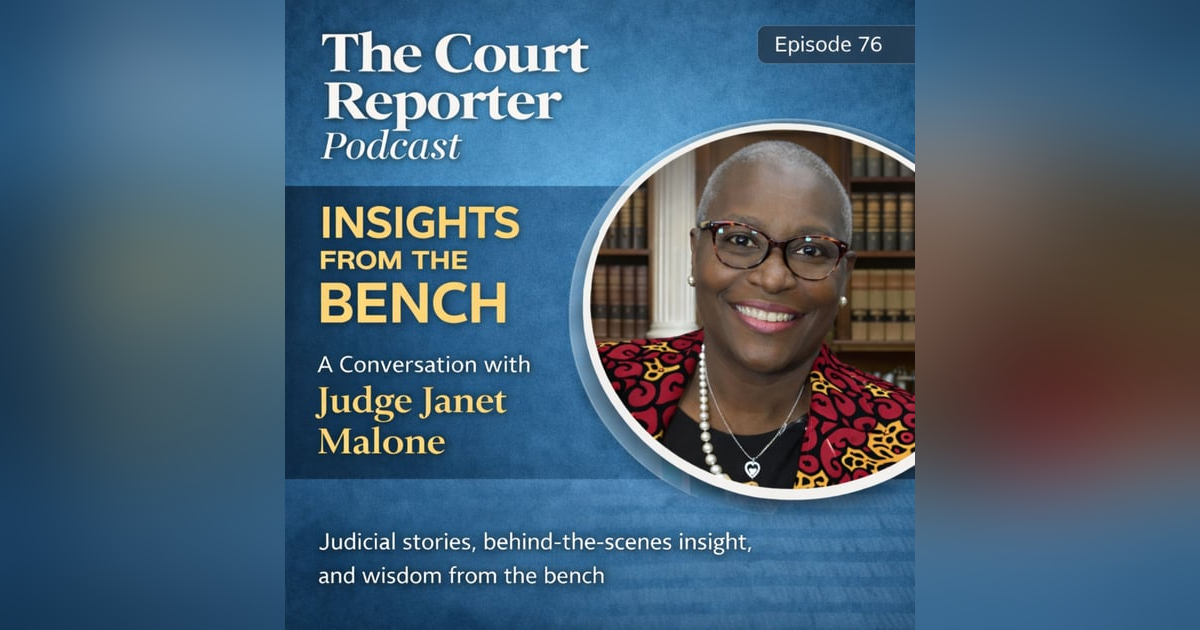


In this episode, I’m joined by Judge Janet Malone for a real conversation about judicial life — the good, the challenging, and everything in between.
We talk about what it’s like to juggle the work itself while also running a business, how important it is for court reporters to speak up for accuracy on the record, and why communication and teamwork in the courtroom really matter. Judge Malone also shares her perspective from the bench and how empathy plays a role in the way cases unfold.
If you’re a court reporter, attorney, or just curious about how the courtroom really works, you’ll get a lot out of this one.
00:00 - Untitled
00:01 - Introduction to Court Reporting
05:07 - Judge Janet Malone's Journey and Reflections
14:21 - Courage in Speaking Up
16:27 - The Role of Court Reporters in Ensuring Accurate Records
26:25 - The Role of Court Reporters in Capturing Non-Verbal Communication
29:54 - Courtroom Etiquette and Communication
39:04 - Transitioning to Family Court Experiences
44:12 - Courtroom Etiquette and Challenges
46:37 - The Challenges of Legal Representation
56:43 - Embracing the Next Chapter
59:00 - The Importance of Respect in the Courtroom
Court reporters hold one of the most important roles in the justice system.We're entrusted with the official records of the courts, and we also have to run our own businesses, which is not something most of us were prepared for.I'm Brynn Seymour, court reporter and life coach, and I invite you to join the discussion about the problems we face and the solutions we create on the unique journey of a stenographer. Welcome to the Court Reporter Podcast. Hello, everyone. Let's give a big, warm welcome to Judge Janet Malone.
Judge MaloneThank you. It's my pleasure to be here.
BrynnThank you for being here. So I. And I'm going to insert your bio after this, but why don't you tell us a little bit about yourself and your history with the firsts and.Well, first of all. Okay, so we were together on March 10 for International Day of Women Judges.
Judge MaloneThat's true.
BrynnYep. The UN International Day of Women Judges.We were here for that special event, and you were one of the honorary judges being recognized for all your hard work and for being one of the firsts. Right. The first women to do something.And so you can include that when you're sharing a little bit about yourself and your background becoming a judge and your story. So go for it.
Judge MaloneOkay. Well, Brynn, thank you very much for having me here. It's a pleasure. Well, again, my name is Janet Malone.I was born on the island of Barbados several decades ago and came to the United States when I was 7 years old. I've lived in Westchester since I was 7.Went through the Scarsdale and New Rochelle public school system, went away to college, then to law school, worked as an assistant district attorney in the New York County DA's office, handling cases involving domestic violence, sex abuse, street crimes like robberies, drug sales and things of that nature. I also had my own practice.I worked at a law firm, and then I went into the court system, first as a support magistrate, and then I was elected as a family court judge, and then I was elected as a Supreme Court justice. I was the first black woman elected to that position in the ninth Judicial District. So I'm very proud of that.I'm even more proud that more young women have come after me. So that's basically it. And now I'm retired. Yes. Barbados.
BrynnYou were born on the island of.
Judge MaloneBarbados in a wooden house. In a wooden house, on cinderblocks with no indoor electricity and no indoors.
BrynnAnd do you remember that? Were you there for a good chunk of your life?
Judge MaloneI was there until I was seven. So I remember, you know, having the kerosene lamps. I remember that, you know, we had outhouse. You had to go outside and scrub your clothes on the.On the washboard, things like that. And everything was by candlelight. It was just simple. It was a simple house on cindavlogs. And, you know, just gave me my humble book beginnings.And it's things like that that keep me grounded, you know, you can never get too far off the ground, you know, and also it creates a certain degree of empathy and sympathy also for situations that. For the grace of God, there go I. So I'm very fortunate for my.I'm very proud of my beginnings because it's really kind of steadied me and set my course.
BrynnAnd did you come from Barbados to. Directly to New York?
Judge MaloneYes, we came right into New York. My mother was already here. My mother was working as a domestic in Scarsdale. So we came into Scarsdale and we lived in the house. My mother.My mother took care of the house, took care of the kids there, went to school in Scarsdale for about maybe two years or so. And then we were kicked out of the house because my mother was taking care of the younger, the youngest child.And I think my mother was taking care of him more than his mother was. And he started to call my mother Mom. And so now the mother took offense to that and decided my mother should leave.And then after she made that decision, she rescinded that decision and wanted my mother to stay. And my mother was like, no, because it wasn't the first time she had told her to leave. So my mother left. We had nowhere to go.And my mother called a friend of hers who was living in New Rochelle, and she took us in. She took us in with all our belongings, gave us her bedroom. She slept on the couch with her then fiance, and they had a little baby.And, you know, so we were very fortunate to have someone to call on. So you just never know who's going to be your angel, you know? Yeah.
BrynnLet's talk about the. Okay. So your career in the law, when did that spring up into your heart? Have you always wanted to be a lawyer or a judge or anything like.Or like, how did you get into that?
Judge MaloneI always wanted to be a lot of things, but I always said that my sister was my first client because on my first day of school, this young boy was bothering my sister, and I kind of beat him up. And then they sent me home and I told them, no one can beat up my sister.And I went home and told My sister, I said, you can't let people treat you like that. So my sister and I always joke that she was my first client. But I.And I. I don't know if I want to say I get myself in trouble or I used to get myself in trouble. But I would always speak up when I thought that other people weren't speaking up.And I would say what I thought other people wanted to say or what needed to be said. And then it just kind of springboard from there. And then I think when I was in junior high, I had this constitutional law class.I'll never forget that, professor. And I was like, wow, this is really interesting. And then around the same time, I was watching Perry Mason reruns and things like that, and it just.I was just. I think sometimes you have a personality that seeks out a profession. I was kind of like an arguer, you know, at home and things like that.And always someone who would speak up. And I never really wanted to speak up. I always wanted somebody else to speak up.But I feel, you know, that we all have a responsibility that when we see something that's not right, to say something, to do something. So then it just became my calling. And then I was like, I would never. I don't want to work in, you know, doing defense work.So I became a prosecutor, and I became a prosecutor, and then I said, I never want to work in family court. And I've learned never to say never, because you just never know, you know, where God's going to lead you and what path you're going to be on.So I ended up working in family court at a family core practice, and I also ended up doing defense work, you know, so.
BrynnOkay, I was going to ask about that because for.When it comes to, like, defense versus prosecution, I always wonder, like, because, you know, you see so many things that are like, how could anyone defend. That's Maybe that's the wrong thought. But I. Sometimes I see that and I'm like, I don't know. I feel like. But then some people. So.So I kind of agree with or not agree, but, like, I kind of probably would have done or chosen the same one. But was there anything, like, any, like, particular reason why you chose prosecution over defense?
Judge MaloneI. I just. Because it was like, the people you were representing. The people, the people, the people. And when I realized, you know, it was, like, so daunting.It's like, you represented the people of the state of New York. So it's like everybody in the state of New York, I get to to represent while in the county of Manhattan. And so you. You know, I don't like bullies.You know, I don't like people taking advantage of other people. And so it just seemed like such a good fit. But when I went into my own practice, it was like, okay, how do we make a living?You know, how do we make a living? And when I said I didn't want to go into family corps, it was because when I.When I was a prosecutor, you would have cases where women would be battered, abused, and they wouldn't want to press charges. And you don't want it to victimize, you know, someone who's already been victimized by forcing them to do something.But it's like, this is for your own good. This person needs to be off the streets and out of society. So it was very difficult. And it was also difficult when you.You had those cases that involved young children. But sometimes, well, majority of the time, it was the mother who didn't want the charges to go forward. You know, you need.You needed the male, whether it was husband, boyfriend, whoever in the household for financial reasons. And, you know, people were willing to make sacrifices of their children. And it was like, oh, my goodness, it would just infuriate me.And so I never wanted to handle those cases. But after a while, when you get on the other side, you get into family court and so forth.And also in criminal court, when you're doing criminal defense, it's not. Sometimes I thought about it this way. I'm not necessarily defending the person.No, I am defending the person, but I'm more so defending the rights that they have.And I think when you focus on the rights that they have and preserving those rights because it's just not for that particular person, it's for everyone, then you take a different view. I remember the first case I had in criminal court, and I was assigned the case.I was on the 18B panel, and it was a case of a rape of a young girl under the age of 10. And I go in to talk to this guy, and I said, you know, I won't be able to do this. I prosecuted cases like this.I am not going to represent this person. And then when I went in there, he wanted to confess. And I was like, but, you know, you have the right to a trial.You know, you have the right to this. You know, you have the right to this. You can challenge this. You can challenge that.And I was all prepared to tell, you know, the judge that I would only handle the arraignment, But I Wouldn't represent him, but he was ready to confess.And so I kind of had the opportunity to then pick and choose, you know, what cases I felt that I could actually represent, even though I was representing their. Their rights. There were some cases that just kind of hit too hard, hit home to her, especially those that involve children.
BrynnOh, yeah, definitely. That's a. That's a touchy one. I know there was. There are a lot of attorneys that I.Or aspiring attorneys that I was connected with that, you know, that was definitely, like, not on there. They were like, I can't even touch that. I can't go that route.Because they were looking for interns, and I was asking around, and they were like, no, that's too heartbreaking. But, yeah, so, okay, so going back to the role of court reporting in the justice system and the record and.Well, not going back, because we haven't even gone there yet, but going to. That. You said something. There was something you said about how you never wanted to be the one that. That spoke up. Right.But you always did because it was the right thing to do. Or, you know, if you see something, you would say something. Is that kind of. Did I understand that correctly?
Judge MaloneYes, you did.
BrynnOkay, so. And was it because you didn't want to be the one to speak up because you were shy or like, you just wanted. You thought someone else would do it or.But you ended up doing it.
Judge MaloneI always thought someone else would do it because I always felt I was young. You know, I'm young. I don't know. But it was always like, a disreaction to what happens. Like, okay, this isn't right.Shouldn't somebody be saying something? And then when I heard silence, I'm like, okay, there has to be a voice here. There has to be a voice here. And I would speak up. And sometimes.And you know, as I got older, I realized people don't really want you to speak up. People would prefer sometimes that you just remain quiet. And I just wasn't created that way.And I think I've really come to understand that I was not created that way, and I was created to give a voice to those who maybe feel marginalized or didn't have a voice, didn't understand the situation. And if I could lend a voice, either for clarity or to educate or just to provoke a new thought, then I felt like I really had to.
BrynnSo, yeah, I mean, the world needs more people like that, I think.
Judge MaloneI don't know if the world really wants it sometimes. Well, I think we do. I think we need people who are willing to show strength of character and to speak up.But I think that our society is, you know, causing people to be a little bit too afraid to speak up because of the repercussions. But if we don't speak up, then where will we be? The world. And change wouldn't come around, couldn't come about if people didn't say something.
BrynnAn example of that, I mean, there was just recently on the news and I try not to watch the news too much because it's like just one thing after another. That's very like, what in the world is happening? But.But like there was one case on the news where someone just randomly killed someone on, on a subway train. Like a girl was sitting and some guy just came up and killed her.
Judge MaloneAnd.
BrynnAnd like, I think there was a lot of talk about the fact that nobody on the bus did or said anything, which was like, everyone was like, that's so weird. Like, why wouldn't anyone do anything or say anything? But then at the same time it's like, what can you do?He, she just got killed, then he's gonna kill the next person. Maybe, like, I don't know, I can understand why. But like, that was just an example of how it would be.So it would be nice to see more courage in the world and more people who are willing to take those risks. And even at this, the sake saw.
Judge MaloneThat with 9 11, that plane that was about to go into the Pentagon, you saw that in 9 11. And those people who lost their lives, but they lost their lives in a courageous way, basically standing up and doing something.And I don't know, I don't know when it's changed that we really just turn a blind eye and a deaf ear to the pain of other people. No one wants to get involved, I guess no one wants to go to court.No one wants the retribution, you know, And I think that we see so much that people who do get, who speak up get knocked down.And I think maybe just too many things are televised these days because all we see bullies and we see people being oppressed and we see people who are just, you know, it doesn't saying to themselves, it doesn't make sense. Whatever I do is not gonna make sense. Any difference. And I think when you live in that kind of world or headspace, you.You just kind of say, okay, I'm going to get up, go to work, do what I have to do, come, I just want to come home safe, lock the doors and that's it. And not Be involved with other people or their. Their situations.And I think maybe, you know, to see something that horrific, Some of the people were probably in shock. Like, like, what. What just happened?
BrynnPossibly deep. Oh, my goodness.
Judge MaloneYou ever had that situation? Yeah. Like. Like, what? Did I. Did I just see what I thought? Did that just happen? You know, it just doesn't make sense. No.Do you ever have that situation where somebody will say something to you or you'll see something and then you kind of walk away, and then it's like, maybe like a minute later you go, wait a minute. Did I just hear what I thought I heard? You know, it's like, did that just happen?
BrynnThat just happened to me. The other day I was singing because I was just. We were at church, and I was walking around singing this random song. I was like, what is the song?Because of you. You know, that's.
Judge MaloneYeah.
BrynnAnd then this one of the guys, he. He just picks up right where I left off, and he's like, I've never strayed. And he's like, across the room singing the. The second half of that line.And for some reason, I didn't register what was happening until, like, I walked away. And I'm like, wait, did he really just start singing that? Like, did I hear that correctly?Because at the moment, it kind of just felt natural, and I was just like, in my own little world. But then I'm like, what?
Judge MaloneAnd I think the brain is very sensitive. It's like, you know, the processing and the process is violence, though. Yeah, yeah, yeah. So.
BrynnSo one of the things you said about speaking up, like, if we don't speak up, then change cannot. Cannot take place, cannot happen. Like, the change that we want to see. So.And when it comes to, like, one of the things about court reporting and court reporter is having that confidence to speak up for the record. Cause the record is very important to preserve and to make sure it's accurate. And sometimes we're not 100% sure what we heard.So it's like, do we clarify? Do we. Do we speak up? Do we interrupt? Or is it not the right time?And there's a lot of, like, overthinking, but we only have a split second to make that decision. So if you could speak a little bit about. When you. When you think about the role of a court reporter in that sense, their duties to control the.Or to protect the record and control it in. In a deposition when there's no judge and in court, to work with the judge, how. What do you think?Like, are there any Is there anything you've seen that has been. That has stood out as. Oh, that was really helpful. Oh, I really like when the court reporters do that or anything good or bad.
Judge MaloneWell, first, I want to say that I have had the pleasure and the honor of working with some of the best court reporters in the 9th Judicial District. So shout out to the 9th Judicial District. They're wonderful, wonderful people.And one thing, it was funny, I was thinking about that on my way here, that the court reporters. I always wanted to be able to see the court reporter in my courtroom. I always had a courtroom, whereas the bench was a little bit too high.So I had to kind of look over like this to see the court reporter. Because even if it's a jury case, you want to make sure that, you know, there's someone who kind of gets what you get.And it was important to me to see the court reporter, to make eye contact with the court reporter at times. And when sometimes the most important is like, okay, did I just hear what I thought I heard?And so I was like, well, madam Reporter, or, you know, Mr. Reporter, can you please read back the question and answer the last two? So I could hear? And I was like, oh, okay. I thought I heard so and so. And they were like, no.And so it's important that there's someone else in the room that's hearing the same thing as you. I mean, not hearing the same thing as you, but someone who can correct you.Because you ever been in a room and it's like you think you heard something being said, and it's like, wait a minute. That's not. No, that's not what it said. It just sounded that way. And so. And so to have that correction, you know, in real time is. Is good.And it kind of resets your. Resets your mind. The other thing about the court reporters that I've worked with, they're not afraid to speak up.They're not afraid to say, you know, counselor, slow down, Counselor, you're. You're swallowing your words. Counselor, can you spell this for me? Counselor, can you ask that question again? I didn't get all of it.Or even to stop the witness, you know, and they can control. They'll stop the attorney from asking a question. Counselor, I didn't get the witness's full answer. Can you just give me a minute, Mr. Ms. Witness?Can you go over again what you just said? I got you up until this part, you know, can you finish this?And so you know that they're always, always paying attention, which is hard it's exhausting to listen to people. It really is. And so the reporters, you know, they're crucial because that's a record for appeal.That's a record just even for the next day or for the next witness in a deposition. You know, there's no one there saying, you know, don't say that. Well, their attorneys are saying, don't say this, don't say that.But there's no judge there. There's no one making the ruling. You can make the objection, but you can mark it for a ruling later on. You can go and call. Call the judge.But in that sense, the court reporters are more just doing the same thing. They're doing the same thing in the depositions that I've been in, asking for clarification, making sure that what's said is.Is taken down and taken down accurately, because now that's going to be used in another proceeding. So like I said, the reporters that I've worked with, they make sure that they get everything down, and they do. They control the room.
BrynnAnd do you notice most of them do it on the spot in the moment, or do they wait until.
Judge MaloneIn the moment. Okay, yeah, in the moment, which is the best thing to do. It's like, okay, counselor, just slow down. Counselor, wait.Now, the last thing you said was, can you pick up from here? You know, and it's like, okay, you're going too fast. And it's also.I think what's important, especially when they're in the courtroom with the judge, is that you have that communication. And it's like, okay, let me know when you need a break. Okay? Because, you know, the fingers are going. Fingers are going.Let me know when you need a break. I will. You know, and when you get work with the same Corey Porters, it's like an eye thing.
BrynnYeah, we develop that.
Judge MaloneLike, the eye is like, now is the time, or, you know, like.
BrynnYeah, and that's a good point about speaking up in the moment, because a lot of court reporters do, like, recommend that you wait until a break or that you just note. Note it and then ask later. But the thing is that I've tried that and. And many times, I just don't get the chance later or later doesn't come or just.Or I forget and something else comes up. It's just like. So I kind of disregarded that. So I'm glad to hear you say that.That's actually what you see, the most professional court reporters do is have that confidence to speak up in the moment. And really, like. Because we Only have a second to make that decision. Sometimes, oftentimes the easiest decision to make is to not say anything.For, you know, for new court reporters or for people who don't have that confidence or who are second guessing themselves is to just kind of like, okay, I'll figure it out later and not speak up in the moment.But, but like, that's because, you know, it's, it's avoiding that discomfort of, I guess, bringing feeling, like they're bringing attention to themselves.
Judge MaloneSo I think that's when the judge comes in, because you can tell, it's like, okay, I don't know how to spell this word, Counselor.You know, if you have a medical malpractice or something that, you know, involves a lot of, you know, big words, it's like, counselor, how do you spell that? So I do that for myself and I, I try to do that for, I try to do that for the, for the court reporters. Can you spell this in, Councilor?Can you slow down, Counselor? I just want you to be mindful that you're rustling your papers and you're at air level to the reporter, okay?I want to make sure that she, she hears everything and also slow down because I don't want her to get mad at me. I used to try to make a joke. I want her to get mad at me. She's wonderful, okay? Or, you know, but her fingers are going to start to smoke, so.Or the ones that would like to talk over me as I have to remind them, you know, if the two of us are speaking, no matter how talented my court reporter is, they're not gonna get down everything and they're not gonna get down what you're saying. So it's all for naught. Okay, so you can't talk over me.
BrynnThese are great phrases. I'm gonna have to make like a PDF list of these phrases for us to, to tailor to how we can use them in depositions and things like that.They're great. Yeah, so. Okay, great. So court reporters are obviously essential in the justice system. So, I mean, I love working with, with judges. I.My experience in court was in the Bronx and there were so many. And surprisingly, as you heard me say during the women judges event, I feel like it's, I don't know, 98, 97% female. Female women of color.And they were, they're just so amazing to work with and they really make our jobs easier. And they, like you said, like you.It's the judge usually doing that, like, stepping in and so that we don't Ever have to, because, you know, if you can't hear clearly, then obviously we probably can't either. And, but even so, you know, you can probably tell when the court reporter might be struggling a little bit.And so that understanding and that compassion that the judges have is so helpful for us.
Judge MaloneThat's important because you're a team. You're a team. If you look at it that way, you're a team. You're getting down the record. I have to make sure that everything gets into the record.So if someone's making a gesture or someone's using their hands to determine, you know, length or distance or something, that you're getting all of that, you know, into the record.
BrynnYeah. And how do you think that should be put put in the record when it's non verbal?Have you seen parentheticals that you liked or that, you know, anything that you appreciate? Because, you know, there's been, I've seen debates about this online about parentheticals, when to use them, when to not use them.In New York, it seems like we use them more than other states because I posted a video talking about parentheticals, just like explaining what is a parenthetical. Here are some of the common ones. Like in New York, we do. Well, we were taught.I was taught at the school I went to, which was Plaza College, they taught us to notate in parentheses, like handing if someone's handing a document or indicating if someone's pointing to their shoulder or measuring something. And then there was this whole conversation about parentheticals and how we shouldn't be putting anything in parentheticals. And.Oh, but, but I never, I never. That's not what we were taught. We were taught to put, to put those things, but maybe not.It's not like a playwright, not like, okay, every single detail of what's happening. So what's your perspective?
Judge MaloneWell, I think of the. It depends on the situation.Like if the, the witness is saying, well, I was here and they were over here and putting their arms out like this, I think that, you know, it's important to say, well, you know, the witness is extending his or her hand out. And if it's a bench trial, are you indicating how the distance from you to the other individual or are you doing something else with your hands?You know, it's important for the record and especially if it's a jury trial and also if it's a bench trial, what are you trying to indicate by making these gestures? And then also if someone's trying to describe their pain, it's like Oh, I couldn't move my shoulder like this.And it's like, okay, the, the witness now is indicating with, with a hand to the right hand to the left shoulder, that they're not able to bring like the elbow up to the same level as the shoulder, et cetera, et cetera. So if it, if it fits in with the, with the testimony, it's important to the. If it's not.Because there's some times where it's like someone starts flailing their arms and it's like, okay, I see you flailing your arms, sir. You know, is there a reason why your arms are going back and forth like that? You know, if you would just calm down. Because that's also.It's important, I think, for the reader, because if it's on appeal, it's like, if you don't say, if you don't put on the record why you're observing, you know, hands flailing, or now that the person's very emotional, they're sweating, you know, you're rocking back and forth, the reader or the appellate person who's reviewing the record won't know why. Then you're responding the way that you are. And like, I've had people get sick also in the courtroom, and it's like, okay, don't go off the record.Just, just keep going. Just keep going until we can get someone in to take the person out.Because you just never know what someone might want to say about what happened to them. So if you're getting ill, you know, just describing it, who's coming into the room, who's doing what, and just keep that. Also keep the record going.And also when I would do the psychiatric cases, if someone was getting agitated, now there's someone coming from the outside, they are taking one arm, taking the other arm, they're strapping them onto a gurney. They're now taking them out of the courtroom. So it's not. Now everything that happened here we have a record of.If something happens outside of the courtroom, then that's on someone else. But I think it's the responsibility of, especially the judge to make sure that everything that goes on in the courtroom is notated.That's why I don't like a lot. I never liked a lot of things off the record. Right.
BrynnYeah. I think that a lot of court reporters, well, court reporters are not, not really like taking all those details down.So I think for all the attorneys listening, attorneys need to.To know that that is so helpful when they, when attorneys speak up and just say, okay, let the record Reflect that the witness is pointing to her left shoulder, and she's indicating about 3ft. I. There was one time I had.The witness was trying to measure something, like, trying to indicate how tall or how big something was, and the attorney was like, does anyone have a measuring tape? But it was so funny because I actually had one in my purse. There was, like, I had a little keychain, a measuring tape keychain, which.It was very random, but that thing actually really came in handy a lot. And at that moment, they were very impressed that I. That I had that and they used it. And this. That's why these conversations are so important.And I think in law schools, it should be implemented, like, for attorneys to hear from the court reporters and the judges, like, these types of discussions about how to get the best record, how to make sure everything is noted. Because sometimes I think they just assume. I think attorneys assume that court reporters are writing that down.But if it's not spoken verbally, it's not being written down unless it's, like, one of those general parentheticals that they teach us.
Judge MaloneBut, yeah, courtroom etiquette needs to be. It needs to be taught or retaught.
BrynnOh, my gosh, this will be so amazing. Even court reporters, too, I would love to have a class about that, because.
Judge MaloneWe would always say, you know, go outside and get business cards. Bring the business cards in. And after Covid, I don't know what happened. A lot of people just didn't have business cards anymore.So it's like, okay, can you write your name down? It's like, okay, can you print your name? All right, we can't read your scribble. Can you print your name down?And then there's some that are very green. Some attorneys that come in and say, you know. And the clerk will say, you know, can you make your appearance for the records?Like, I already gave my name to the reporter. I was like, jeez, that's not how we do things. Okay, that's not how we do things. Just make the records.
BrynnOh, my gosh. I can't tell you because I'm, like, a very shy person. So it takes me a lot to coach myself and get confident to, like.I have to train myself to really speak up and to set those boundaries and to know exactly how far am I going to let people take it and when am I going to. How am I going to respond to certain things.
Judge MaloneBut I think if you have a strong judge and a judge who's, you know, you're here with, then that shouldn't Be a problem.
BrynnYeah.
Judge MaloneAnd I think that's why it's important to have a conversation that if you're new to the judge's courtroom, court officers, court reporters, have a conversation with the judge. How do you like things? How do you like this? How do you like that? You know, and there are times, and I think, as I said, you're working as a team.So if you didn't ask, you know, or if the attorney didn't say, well, they were indicating that they were five feet away, you know, then you have to say, you know, the witness is doing this. And it measures approximately. Whatever, whatever. And the same thing with the court reporter. Madam reporter. Did you get that?And sometimes the reporters would say to me, oh, no, I didn't, Judge. Thank you. You know, can you repeat it? Because I guess you were going a little bit too fast, you know, or my ears couldn't catch up.I was trying to make a joke just so people didn't feel like, you know, you're really kind of putting them on the spot, especially if there's a jury there. You know, it's like, oh, good, it's Monday morning. My ears aren't working that fast. You know, just slow down for them. You know, that kind.
BrynnYeah. There was a time where in. I was in court, and actually the judge misspoke. She said something.She said a number that was clearly not the number that, like, you know, she was trying doing the math, adding up the awards for the damages done and. And the amount that she said, the way she said it when I was looking. Well, I knew immediately, I knew that something was off.Like, the way that she said it, it wasn't going to work out with the transcript. Well, but then later. But I didn't say anything at the moment. Cause I was like, okay, it's not my role to correct the judge. To correct the judge.Right now. I'm just gonna, like, see what. What it is later.So I was looking at it later, and it came out to like 22 million something the way she said it, which was not. It was supposed to be like two, not even a million. Like, you know, it was 28,000 or something. But it came out to that. So I was like.And then that one also was a big conversation because I was asking court reporters, like, what would you do in this situation if you knew that the judge misspoke? We are not supposed to correct them, but, like, how would you handle this? And so there was a lot of different, like, opinions.
Judge MaloneWell, the court reporters that I work with also go Counselor, could you repeat that number again? And. And then kind of look at me, it's like, oh, that's what you heard? I'm like, yeah, okay.Because I always felt like the court reporters were looking out not only for the record, but also for. For the judge. They're just like, you know, did I. I was like, oh, I thought I heard so and so and so. I wasn't sure what.And then there's like, well, I wasn't sure what I heard. That's what I would ask again. But, you know, the job is to get the record. So I don't think that you're correcting the judge. You're.
BrynnYou're basically looking out for it. I like that.
Judge MaloneYeah, exactly.
BrynnLike taking the responsibility to. We want to make sure that we're getting the record accurately.Not just that we're robotically typing every single word that that is spoken, but if we hear a mistake, it's kind of like, if you see something, say something like, exactly. I think that's nice for court reporters to do.
Judge MaloneAnd I know the one thing that used to annoy the court reporters that I worked with is when the attorneys would give a number. 2209. Okay, is that 2002. I know my line, nine. Or is that. What is that? Could you just give it out? And as soon as.When you're reading the transcripts, you're like, wait a minute. What was the number?
BrynnAnd that's why it's safest, I think. Like, when that does happen too much, it's like, okay, I can't. I can't interrupt every single time.So I'm just going to write exactly what they said, which is like the whole number written out. 22.
Judge MaloneI don't know. I would always stop and say, Counselors, you mean 2,229.
BrynnBut then if they keep. What if they keep doing it?
Judge MaloneWell, then I would just ask them not to. Can we just, you know, just state it properly? Just tell me how many dollars, how many cents.You know, let's do this the right way, because that way the reporter doesn't have to keep. They don't have to stop. They don't have to stop and don't listen, because maybe it's how you approach it.
BrynnIt's interesting. Yeah, that's true.
Judge MaloneMaybe it's how you approach.
BrynnMaybe you can. If you have any tips on, you.
Judge MaloneKnow, you just say, you know, we would like. I would like to have an accurate record, because we just do the dollar. Let's make sure that we. That the Math is correct. Okay.We don't want to shortchange anyone. So if you could just give me, you know, just like, if you were writing it out, just give me the dollars, give me. Give me the cents.I just want to make sure that I keep the right notes.
BrynnHave you ever seen a court reporter who said the same thing so many times that, like, they just. And the attorneys kind of just didn't. Didn't get it and didn't implement it until maybe they did something dramatic?
Judge MaloneNot the ones I worked with. No. They made it very clear. They made it very clear.Now I'm thinking of one right now, and she was like, counselor, and she was just saying, you know, judge, can we just stop? And they would kind of look at me, and it's like. Or get up and come up to the bench and, you know, judge, can I come up?And, you know, we kind of work it out, and I could be the one to say. And then there are other personalities. Like, okay, Counselor, I keep asking you to please stop doing that. Okay. I think it's.It's really a personality.
BrynnI think at some point, it has to be, like, really made clear. Like. Like, if they don't. If they keep ignoring.It has to be like, okay, I'm gonna stand up this time, or, like, I'm gonna do something different to really get their attention. Cause why are they not getting it? Like, they're not listening. And so I think that can get frustrating when. When.Because there are certain people that just don't.
Judge MaloneI think they don't get it because I think that. Yeah, they're. The phone space. Exactly.
BrynnAnd that. That can be, like, a little frustrating. But, you know, there are solutions. We just have to have that confidence to learn how to.
Judge MaloneBecause I feel everybody, you know, I control everything. Here's the bench. When I was on the bench, I control from here back. Told my court officers and the reporters, you guys control from here to there.Okay. If something. If someone's wrestling, give me the eye if I don't catch it or something like that. If I. If I do something.If I say something that's wrong or I. At the wrong numbers, there's. I mean, you have to take the personality out of it. Yeah.Because it's about having the right record and preserving that record. Because everyone has a right to have a. You know, have a review. Have an appellate review. So I start. I stopped taking that personally a long time.
BrynnYeah.
Judge MaloneYou know, let's just get it right. Let's just get it right. And I was fortunate to Work with Corey Porters, who made sure I got it right and everybody else got it right.So, again, 9th J.D. they're the best. They are the best. Yeah.
BrynnCourt reporters kind of have to develop that. The ones who are shy, like me, and who are introverts kind of have to, like, work a little harder than the other ones to develop that.And it's something that comes over time, I think.
Judge MaloneIt does. It does. I guess, because in an.Also, it's just knowing the judge and having that comfort level, because some judges don't want you to say anything in the courtroom. They want to be the ones in control.
BrynnYeah, yeah.
Judge MaloneThat was never meant.
BrynnThat happened to me one time. I can't remember what exactly, but I remember the court reporters.We were talking about how certain judges, like, this is my court, can't explain the thing. Yeah. Like, even anyway, if it comes to me, I'll say it again. But. But, yeah. So there's deposition reporting, and then there's in court reporting.So as. As a judge and as an attorney, you've done it all. You've done. You've gone through having your own business, having your own firm, having your own.And then doing the depositions and the freelancing and. Well, I guess it could be considered freelancing, or it could be considered running your own business, but. And then you've also done court.So you've been through it all. What do you think is. Which one has been your favorite and why?
Judge MaloneMm, probably the courtroom.
BrynnProbably Supreme Court. Right. It's more controlled, more mature, probably.
Judge MaloneBut I would say, though, family court, I loved family court, and I didn't leave family court because I didn't love it. I wanted a different challenge. And in family court, you really did. You made a difference in people's lives.You affected how parents interacted with their children, the time they would spend with them, their access to them. It, you know, also giving.Whether you know, what kind of disposition to give to a juvenile or a person in need of supervision or pence, you know, a family offense. Those were the really. The cases that really hit home in Supreme Court. I was looking.I think I was looking for something a little bit more cerebral, you know, and less emotional.And I guess the Supreme Court, I guess it depends on the system that you're in, whether it's a pure IAS system, whether it's a modified system and the control that you had. And then there were some cases that were really serious. Then there were those cases that, you know, you cut down my tree.Like, okay, you cut down your tree. Okay. You put your fence to far onto my property. You know, those things. And it's like, you know, you're really going to bring a lawsuit.It's like you want just to try to do mediation. And no one wanted to do mediation on that. It's like, you know, I don't know if that's the kind, you know, like, try to settle this. Your neighbors.Do you ever feel like settle.
BrynnYeah, you probably feel like, like a mom trying to get your kids to.
Judge MaloneGet along with each other, not eat your vegetables.
BrynnOh, my gosh. It was so crazy in court. Like, I was. Sometimes I just couldn't believe my eyes and ears. I was like, is this really. Are they really.
Judge MaloneNo, you're really paying. And then there's those cases where you go, okay, now you're paying an attorney. You're taking. You're going to take time off from work.You're going to bring in an expert. And don't. Have you done the math. Isn't that going to cost you more than what this is really worth? I mean, it's like you're.You're putting out more money than this is worth. When you start, you know, doing the arithmetic, it's like, come on. Exactly. Let's figure this out. Is this really something you want to do?That's why I think mediation is good. But some people just, I don't know, I think after a while, it's like, you know, I want somebody to say I was right.You know, they want that kind of indication. I want someone to say that I was right and you were wrong. So I can tell you again in the future that you were wrong.And it's like, you know, it's not always about that. How much money are you willing to spend? You know, how long, how much time? Exactly how much time do you want to go through two years of your life?So what is it worth? And I just think that, you know, mediation is a good way to get those cases that need mediation, like, out of the system so it doesn't clog it up.So you get the more serious cases going to trial.
BrynnDefinitely. What has been the hardest part of being a female judge and being the first black woman to be a judge in the ninth. J.D.
Judge MaloneI think those attorneys, whether male or female and of a different hue, look at me like, I don't know what I'm doing. That's been sometimes the most frustrating. Like, don't man or woman speak to me. And women do it to other women also.And that was something that I really, that really got under my skin. And I would say to myself, you know, you got this. And I think if you're.No matter what career you're pursuing, you have to have a certain confidence level so that it's not shaken when people come in and want to challenge you. Or when an attorney comes in and is like, counselor, I'm not exactly sure why you're yelling. I think we can all hear you. Okay.Or they come in and it's like, you know, they're ready for war. And it's like, okay, let's bring the temperature down a little bit. Let's bring the temperature down.
BrynnYeah.
Judge MaloneMy favorite thing is, you know what? Let's just take. Let's take five minutes or maybe 10.
BrynnEverybody just go outside, get some fresh air.
Judge MaloneYeah. Or I tell people, you know what? I need a break, because I don't like where this is going. Okay. And so it's that thing.It's like, okay, who are you putting on a show for? And I think that if you've gotten to the point where there is such disrespect for the bench, I think we hear it on television a lot.We see it by some of the attorneys. They're more afraid of their clients than they are of the judges. There used to be a time where, you know, you would.People cared about how they came to court.
BrynnOh, my gosh.
Judge MaloneIt's not like that anymore. And it's like, what are you, you going to a bar? It's like, where do you think they're going?
BrynnYou know, pajamas, Like.
Judge MaloneYeah, exactly. And it's like, oh, open toed shoes. Oh, see through shirts.So it's like, you know, just the way you dress, and when you come into the courtroom, it's just like, you. You already know.
BrynnThere was one time someone showed up. Well, even on, like, the fact that Zoom is now an option in some, like, in family court. I remember Zoom was.Well, actually, even in Supreme Court, too, it was an option. And some people would show up in their beds or in their cars. On the bus with the windows down. One person showed up shirtless and.And that at least the court officers were like, in some of the court officers are amazing. And they were just like, I'm not standing. We're not. We're not having this. Not in our courtroom.Like, go put a shirt on and then come back because you're in court.
Judge MaloneExactly. And I always felt really uncomfortable when people would appear from their bedrooms. I'm like, I don't.I don't want to see I really don't want to see where you're like.
BrynnI didn't want to appear that way like that. That's so uncomfortable.
Judge MaloneThey have. And it's like, I remember this one guy, he showed up, and it was like, he had no shirt on. And I was just like, sir, I appear not to have a shirt.Would you possibly. And then he comes back with, like, this. A white. Well, I can't even call it white. A little dingy T shirt that was, like, the collar was out of shape.Was. You know, had no shape to it.
BrynnI was like, you're gonna say a beater, you know.
Judge MaloneI was like, okay, so this is what you think of the proceedings. That level is. That's gone. You know, the level of professionalism and just courtesy to. It's like, the attorney didn't do anything to you. Okay.That's what it frustrates me when the attorneys wouldn't even speak to each other, or at least. Or if there was one attorney that wouldn't speak. And I was like, what are you doing?And then when I did, matrimonials was like, oh, he or she, they're liars. And I'm like, excuse me, that sounds a little personal. Do you mean that your client believes that the other side is lying?Because now you're making it sound like, you know, that you're taking this personally. Maybe you've been on this case a little bit too long. And it's like, cases do last. They do.And then you start taking on the characteristics of your client. It's like, whoa, we need to dial this back. Because you're supposed to be objective, so how can you.How can you advise your client if now you're not being objective? You're not seeing things clearly? That's why they say you shouldn't represent yourself. Right.But now if you're taking on the identity of your client, you start to have an issue. So it was. That's what always bothered me is just that the level of professionalism, the level of preparation.
BrynnOh, my gosh. Preparedness.
Judge MaloneOh, my goodness.
BrynnAnd I was like, you can totally tell.
Judge MaloneOh, yeah. When they're like, do you know why you're here? Do you know why you're here? You know, like, why.When you got up this morning, what did you think you were coming here to do? You know, it's so. It's.
BrynnAnd it makes everything take longer.
Judge MaloneYeah.
BrynnAnd it's like, yeah, preparation is amazing when those.
Judge MaloneAnd then the worst is when an attorney is not doing what he or she should be doing on a case, like there's a discovery schedule, things that need to be done, and they're not doing it now. The other side is making a motion that's going to impact the case.And you go to yourself, you say to yourself, okay, now always in family court and matrimonial parts, the parties had to show up. But, you know, in civil cases in Supreme Court, the parties don't have to show up. The attorneys are showing up.Then you say to yourself, do the clients really know what you're doing? Do the clients know now that you know because you haven't done certain things? Their case is that close to being dismissed.And so those were the cases that always bothered me because I always wondered, what does the client know?And although you have the attorney before you and it's the attorney that you're sanctioning or that you're somehow punished, it's the client, it's the parties. And now that becomes their view of the system. They threw out my case. But did you know that your attorneys didn't do X, Y and Z?Did you know you were supposed to show up for this, that and that, and you didn't show up for the deposition. You didn't do that, and they didn't know. I did that one time. And I brought in, I said, you have to have your clients come in.Oh, no, my client, whatever is convenient for them, but they're going to come in. And then at the end, the client said, we didn't know that this was going on. We didn't know.
BrynnYeah, I hear that a lot too.
Judge MaloneYeah. But we shouldn't be. I know we shouldn't be hearing that. You know, so those are the things that. That really bother me.
BrynnYeah. And so before I ask the last couple questions, what's the time check? I don't have anything on me. I have no phone, no watch.
Judge MaloneWe're good.
BrynnNo clock in the hue. What time is it?
Judge MaloneIt's 5:30. 5.
Brynn5:35. Okay, so five more minutes. Okay, so. Oh my gosh. Now I just forgot what I was gonna ask. Okay, let me think of my.
Judge MaloneSo ask something else. And then that was.
BrynnI know. Cause I'm like. My mind just went blank. I'm like, okay. Oh, yeah. So we were talking about your. The hardest thing in. In your journey as a judge because.Well, one other thing that must be. That might be difficult is I. I'm curious how you and how judges handle the emotional aspect of. Of this. And then.Well, of course, there are a lot of emotional cases, but not I guess separate, not, not the emotions of the case, but like when it comes to making the right decision, making decisions is such a. Even little decisions that we have to make in our day to day life are difficult, right?Like even what to wear and what to eat, those are the things that we try to delegate by routinizing and not having to use our brain power on those. But then you're here making decisions all day that are very important because people's lives depend on them.So how do you, how do you like, does that, how do you handle that pressure?And has there ever been, you know, times where you're worried about the decisions that you're making and you know, obviously you can't please everybody. So, so. And then there's the law that it's based on, but there's some level of understanding of everything that happened.So speak a little bit about the difficulties around that and making decisions and how you handle that.
Judge MaloneWell, when I was in family court, a lot of the decisions were difficult, but in those decisions where either I was making a decision from the bench or a written decision, and if I'm not ruling in your favor, I take the time to explain why I'm not ruling in your favor.And I think it's also, it's important to put into the record things that the witnesses said or the parties said or the attorney said to say, let me know. I heard you, I heard what you had to say. And even if I was to consider this, the law does not allow it, this is really not relevant.Or it didn't have any support, or it wasn't this, it wasn't that. So it's not like I didn't hear you, I heard you, but this is why I don't and I can't rule in your favor.And so I just think it's very important that people know that they heard and to explain. I always think that that's what we can do.You know, that's what judges can do from the bench when they're giving a decision, it's what they can do in writing.And I think that even if you're not happy with the decision that I made, at least you can say I gave you your day in court, I heard what you had to say. I gave your attorney or you, if you're pro se, the opportunity to present your case. And this is what I took away from it.And this is why we are, you know, the outcome is what the outcome is. And so hopefully they'll say, you know what, thanks. I think that's the greatest thing that I could ever do.I've had attorneys who said, you know, I didn't always like the, you know, your decision, but I know that you had the opportunity to be heard and that you. You gave me the opportunity to put on my case. And I think that's the greatest compliment.
BrynnThat's so amazing. And I love how, like, I love that you said that you like to explain the reasoning behind it. Because honestly, I. I feel like this is.This might sound funny even in things like going to the hair salon, for example. When I go to the hair salon and they're doing something that I don't really know what they're doing.I love when they are explaining what they're doing and why. Because that's such a funny example or such a funny thing.
Judge MaloneNo, it's like your doctor also is like, what? I'm. Okay, like, what does that mean? Yeah, can you break that down for me?
BrynnOr like, one time I got like, a lash lift and. And, you know, like, you go thing. And then they clear eyes and close, and you feel all this, like, stuff on your face.
Judge MaloneAnd.
BrynnAnd I just. There was one, I think. Well, no, I don't know. They just.I just wished that they were explaining what they were doing because I was, like, so curious and so interesting.
Judge MaloneYou're still vulnerable, though, you know, because you're there with your eyes. They're kind of sealed shut, and it's like, okay, what are you doing? And am I gonna. Like this when I come out?
BrynnThose lash lips are actually, like, when they. I don't know what it is, but it makes me so tired and fall asleep anyway. But in the beginning, I wanted.I remember wanting to know, what is she doing? Can you explain to me every step.
Judge MaloneBecause I can't see you.
BrynnYeah, that's such a. So I'm sure they all appreciate you explaining and being.
Judge MaloneI hope so.
BrynnYou know, I mean, that's such a good extra step to take, because when it's not explained, when things aren't explained, or when things don't go the way that you want them to go and it wasn't explained, it's kind of like they're always going to be wondering, like, and thinking about it, and it's going to bother them. And I know it does for me sometimes.
Judge MaloneThat's why I always liked, like, the formality of a courtroom, because when people, even if you know the attorney or the attorneys know the court reporters don't come into the courtroom not being all, buddy, buddy, all right. Or having A conversation in the courtroom on the other side is there. It's not a good look. It's not a good look. And I have.I've said that to court reporters. You know, if you want to speak to this person, let's not do it in the courtroom in front of everyone.Okay, you guys can have the conversation, but don't do it in here. Because I don't want anyone to walk in and say, oh, like, you know, everything was already predetermined. That's not the case.And I never wanted to give that impression. So it's like, okay, I know you, you know me, fine, but we'll know each other outside of the courtroom, not inside the courtroom.Don't give the appearance that one side, you know, is buddy. Buddy with either the judge or the court reporter, and the other side is sitting there looking like, oh, this is how we're working.
BrynnNo, I agree.
Judge MaloneLet's not do that. Let's not do that.
BrynnImpartiality is very important for us court reporters. And perception. Yep.
Judge MaloneBecause you always say, you know, everyone's perception is their reality, so it's how you perceive the court. So I would just keep it neutral and let everybody have their say, even though sometimes, like. Objection. Okay, yeah, yeah.
BrynnWe're held to a high standard for that. So. Okay, so now that you're retired, congratulations. What are you. What's your next chapter in life?
Judge MaloneI don't know yet. I have a friend who. She calls this my discernment phase.And I told her when I discussed with her I was going to retire, she was like, well, take at least two months for yourself. I haven't been able to do that because I've been very busy. Busier than I really thought I was going to be.
BrynnAnd what was your official date of retire?
Judge MaloneJune 30th. June 2025.
BrynnSo you've had two months?
Judge MaloneJuly, August, 3, 4. But I'm busy. I have not.
BrynnBut you haven't slowed down.
Judge MaloneNope.
BrynnBreathe.
Judge MaloneI have not had the chance to breathe. And it's like when people know you're retired, it's like, okay, let's have lunch.It's like, there's a lot of reconnection, you know, you're reconnecting with people. I'm just like, oh, my goodness.I lost contact with a lot of people, so I've been having a lot of lunches, a lot of dinners, you know, breakfasts, and reconnecting with people doing different things. But I've been busy.But I mean, it's kind of on my Schedule and I'm taking care of me in there, and I get the opportunity also spend time with my mom and do things with her. So my sister and I have more of a balance load when it comes to mom, and it feels good, but I don't know. I know there's gonna be a next chapter.I don't know what that chapter's gonna be. You know, it might just be all about me and nothing else, or it might be that I find a place where I can lend my voice and speak up or I write or.
BrynnWell, this has been, like, a really, really good conversation, I think, for court reporters and for attorneys. A lot of the things we talked about, I think, are really, really key in. In making a good record. And so thank you so much for.For coming and for talking about these things. And I really think that you have so much more to share and so much to offer.And, like, I just want to ask you so many more questions, but I can already hear it sounds like they're telling us that it's our time to wrap up. But what would you. What would be your last words to share?Any words of encouragement for court reporters and impartial guardians of the record and overcoming difficulties and just kind of persevering and anything that you have experienced that you can share.
Judge MaloneOh, that's a lot.
BrynnI'm sorry. I'm so. I would be the worst attorney. I'm not good at asking questions. I'm like, okay, here's the whole word vomit. Now. Just pick what you.
Judge MaloneI would just say, you know what? Just be your. Be yourself. Be authentic. Be who you are, because that's the best person that you can be.And don't let people try to turn you into something else. And professionally, when we're in that courtroom, I always say we're a team. The court clerk, the court reporter, the court officer, the judge.You're a team, and you're there to. To treat people with respect, to make sure that the best record is made. There's nothing wrong with saying, I didn't hear what you said, Counselor.Never be afraid to speak up. See, we're back to the beginning, right? Don't be afraid to speak up. If you didn't hear something, ask in the moment.Because if you wait till the end and say, well, what did you mean when you said. I was like, wait, when did I say? Yeah, when did I say that? You know, be. Be in the moment. And.And I think at the end of the day, when we give respect, we. We get respect back. I think that the core report is, again, 9th JD they are, you know, they're professional, they are courteous, they are supportive.
BrynnAnd when you think the 9th J.D. that is Westchester, it's Westchester.
Judge MaloneWell, the 9th Judicial Judicial District is Westchester, Rockland, Orange, Dutchess and Putnam.
BrynnOh, okay.
Judge MaloneI've worked in more than one county, so when I say the 9th JD I want to make sure that I include all the court reporters, but mainly I worked out of Westchester.
BrynnOkay. And White Plains.
Judge MaloneWhite Plains.
BrynnI've been looking for work there because I've taken my time off and now I'm trying to.
Judge MaloneYou're trying to.
BrynnTrying to get back in because I still don't have my New York notary. I tried. I failed the test, like when I first moved back from Maine.So I'm like, okay, I'll just work in court because you don't have to have your notary in court, but with freelancing, you do. So I am reach. I've been persistently reaching out and hopefully that's.
Judge MaloneYou'll get it. But timing is everything.
BrynnYes, but, yeah, that is such good advice. Respect and respect will be given back to you. And.
Judge MaloneAnd sometimes it's not.You gotta grab it like, people know you're not here to be pushed over and that, you know, you have a role and they have a role and you'll respect their role, they respect yours.
BrynnAnd that's it. Exactly.
Judge MaloneThat's it.
BrynnBecause honestly, I mean, it's not about us necessarily being respected as people, but as. But for the sake of at least the record, they should respect the records and the institution.
Judge MaloneThe courts. The courts are important.
BrynnThe justice system. Yeah.
Judge MaloneYeah. So very important.
BrynnYes, so important.
Judge MaloneAnd I think what people think of the system when they walk out of a courtroom is important. So what they see when they've come in, you really have to. I think you have to be on P's and Q's, but you have to, because you're being watched.And you can leave an impression, either positive or a negative impression on the people that come in. And when I was on the bench, I was one of people to leave with a positive impression.
BrynnI love that. That is so important. And not all judges are, you know, I can really see, like, I can really see when judges are conscious of.Of that, and it's so, so beautiful. So thank you for being like that. And so, yeah, I would love.I wish that I had time to ask you more about, like, I remember at the women judges event, there was a question, and I loved your answer. Your answer was like, the best. It was about, like, time management and overwhelm and. And your answer was just so awesome.It was like, how do you balance your life? And you were like, you just don't.
Judge MaloneYeah.
BrynnAnd I wish I. I wish we could, like, dive into that topic because that would be. Oh, yeah, such a great topic. But perhaps we can do a part two and, yeah, we could do a whole series. This is so amazing. I love this.So thank you so much for coming onto the podcast. Any matchwoods you want to share, anywhere people can find your information or find out more, like, about what you're doing.
Judge MaloneI'm not on social media.
BrynnI mean, you're a judge. Judges. You can't find social media.
Judge MaloneI think it could be a very dangerous place. I mean, I haven't been on social media. I've never been on social media. I don't like what social media does.It's like anything, everything that's good, being taken to the extreme and just being, you know, just not doing the wrong thing with it. You do.
BrynnThere is an amazing bio about you on online and Utica University. I believe that's where you went to school. Yeah, that one's really good.Your story, oh, my gosh, your story is so amazing, which is why I would love to do a part two and three. So anyways, thank you so much for. For coming on. And yeah, everybody can find.
Judge MaloneGo.
BrynnGo check out Judge Janet Malone on Utica University's website.
Judge MaloneAll right. Go check that out too.
BrynnIt's amazing.
Judge MaloneI love it. Thank you so much. It's really been a pleasure. Thank you.
BrynnThank you and all the listeners. Thank you for listening and we will catch you in the next episode. Have a great day. Bye.
Judge MaloneSa.


