#78 - The Ghost in the Statute: New York’s Ambiguous Authority Crisis
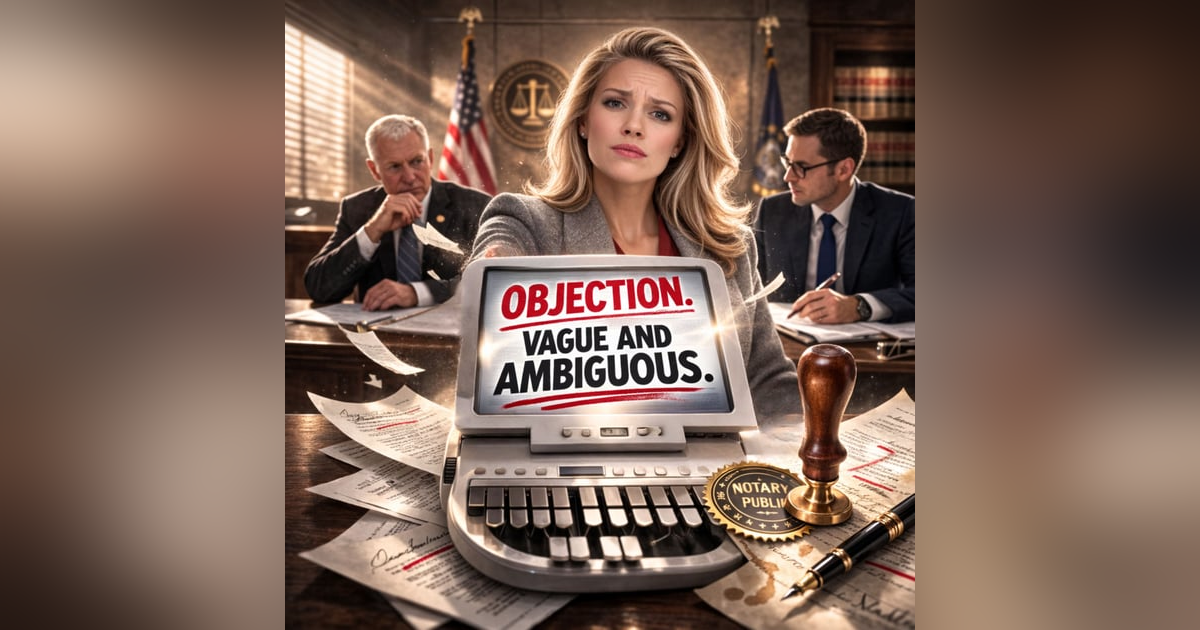


This wasn’t the episode I planned. I had a script ready, but I threw it out for something more honest.
This is a "sprawled on the floor" conversation about the deep insecurities of working in a system—specifically New York's—that feels designed to keep us in the dark. We’re diving into the "New York Glitch": the jurisdictional ambiguity other states don’t have, and the moments I almost walked away from court reporting entirely.
If you’ve ever felt like you're walking on thin ice despite your experience or credentials, this is for you.
Companies mentioned:
- New York Career Institute
- Plaza College
- National Notary Association
- New York State Unified Court System
Welcome back to the new season of the Court Reporter podcast.
Speaker AWe are in Q1 of 2026, we are in quarter one of 2026, and we're going to be talking a little bit about the notary test and professional practices, professional development.
Speaker ASo if you're a court reporter, which most of you probably are, chances are you did not become a notary because you wanted to notarize documents.
Speaker AChances are you are living in a state that either requires the notary in order to to perform your duties as a court reporter as a part of that certification, or you're living in a state where there's folklore around that and people have made it a custom and have emphasized it to the point where you think it's a law, but it may actually not be.
Speaker AAnd that is why most of us are notaries, not because we actually need to be to perform our duties.
Speaker ASo you became a notary because or you.
Speaker AWe believe we became notaries because we needed to administer oaths, certify transcripts, and do our jobs properly.
Speaker AWe thought that that's what the notary helped us to do, or at least that's what I thought, so.
Speaker AYet, notary law often feels confusing, overwhelming, and honestly, just a little disconnected from what we actually do in practice.
Speaker ASo in this mini series, I'm going to break down the notary law, specifically for court reporters.
Speaker AWhat truly matters, what exists just to pass the exam, if you really need it for your state, and how to protect yourself from accidentally doing something improper without even realizing it.
Speaker AWhether you're studying for the notary exam right now or you've been a notary for years, this series will improve your clarity, confidence, and peace of mind.
Speaker AOr it'll be a a good refresher.
Speaker AWelcome back to a new season of the Court Reporter podcast.
Speaker AIn this season, quarter one of 2026, we're going to be starting with a series about the notary law.
Speaker ASo if you're a court reporter, chances are you didn't become a notary because you needed to notarize documents.
Speaker AYou became a notary because you were told that you need to be able to administer oaths and that the notary is what allows you to do that.
Speaker AYou need to be able to maybe certify transcripts and do your job properly, and that the notary gives you the authority to do those things.
Speaker AYeah, notary law feels very confusing, overwhelming, and honestly, just a little disconnected from what we actually do when you take a very close look at it.
Speaker ASo in this mini series, I'm going to break down the notary law.
Speaker AWhat specifically does apply for court reporters?
Speaker AWhat matters and what exists just to pass the examination?
Speaker ASo basically, like, what do you need to actually understand versus what do you need to just memorize to pass the exam?
Speaker AWhich I personally, I just, I have a little bit of a problem with that.
Speaker AI. I just don't like that we have to memorize things just to pass an exam when we don't really need to use it, because if we're not using it, we're not practicing.
Speaker AAnd if we're not practicing it, we're going to forget it.
Speaker AAnd that's just how things go.
Speaker ASo whether you're studying, whether you're studying now for the notary, or you've been a notary for years, or maybe it doesn't apply to you, this series will give you clarity, confidence, and peace of mind around this issue.
Speaker AOr it might just be a good refresher for you.
Speaker AOkay, so let's dive into my specific journey with studying for the notary exam.
Speaker AI'm just going to rewind and, like, talk about my entire experience from day one of becoming a court reporter and getting my notary and just, like, give you an overview of my timeline with regard to the notary.
Speaker ASo, and.
Speaker AAnd this is kind of recapping episode four.
Speaker AIn episode four, entitled Avoiding Notarial Errors or something like that, I talked about my story with the notary for the first time.
Speaker ASo this is now adding on to that story.
Speaker ASo first it was, I went to New York Career Institute, which is Plaza College now in Queens.
Speaker AAnd it was in person at the time.
Speaker AI was commuting every day.
Speaker AAnd I graduated in 2016 after 13 years.
Speaker AI mean, 13 years, 13 months.
Speaker ASo 13 months it took me to get from zero to 225, actually to get from just the beginning of theory to 225.
Speaker AAnd I graduated in, like, December 2016.
Speaker AAnd I honestly, like, it's such a blur.
Speaker AI don't remember taking the notary test.
Speaker AI don't remember studying for it.
Speaker AI don't remember how I studied.
Speaker AI vaguely do remember another student giving me, like, a manila folder that she had used to study for her test.
Speaker AI don't remember looking at it.
Speaker AI mean, I think I like, scanned through it.
Speaker AMaybe you read it, but I just.
Speaker AI really don't remember.
Speaker AIt's all a blur to me.
Speaker AThat was such a long time ago.
Speaker ABut somehow, miraculously I passed the exam.
Speaker AI guess it was really just God's will.
Speaker AAnd I don't know, it happened.
Speaker AI passed the exam without really knowing much about what I was doing or having a full understanding of the notary.
Speaker AAnd I was like, okay, good, now I'm.
Speaker AI'm allowed to do my job.
Speaker AYou know, I was so eager to start working.
Speaker AI didn't think much of it.
Speaker AI was just excited that I passed and just jumped into it.
Speaker ABut I always knew deep down in the back of my mind, I kind of knew.
Speaker ALike, I kind of felt like maybe, am I a fraud?
Speaker ALike, am I.
Speaker AAre there things that I really should understand that the notary trains you or prepares you for in this career?
Speaker AAnd mind you, I shouldn't really be questioning my.
Speaker AYou know, I feel like in school there are probably.
Speaker AMaybe there are more thorough schools, or maybe it's just because I went through it so quickly, but I just feel like I didn't fully.
Speaker ALike, there were just a lot of questions that I had about the career and the field and the industry and the judicial system.
Speaker AAnd I just felt like I'm not equipped.
Speaker AI'm not really, like, the person.
Speaker AI'm not the right one for this.
Speaker AI don't know.
Speaker ALike, I feel like I should have been.
Speaker AI should get a bachelor's degree here.
Speaker ALike, there's so many questions that I have, and I don't know who to ask.
Speaker ALike, you know, so I know we have mentors, but it just felt like there would be questions that pop up.
Speaker AAnd I talked about this in the last episode, in the New Year's launch episode about how I would sometimes really not even feel confident in what different types of proceedings there were.
Speaker ADepositions, EBTs, hearings.
Speaker AI mean, you know, it's like.
Speaker AIt just felt a little overwhelming and confusing.
Speaker AAnd I just wish that there was a class or something that prepared me for all the different types of proceedings.
Speaker AAnd.
Speaker AAnd there probably was.
Speaker AAnd maybe I just didn't, like, retain it because I went through it quickly.
Speaker AMaybe I just was in memorization mode.
Speaker AMaybe I didn't have a fundamental understanding.
Speaker ABut it just.
Speaker AI didn't grow up in a family of lawyers or with people in the law.
Speaker AI grew up with business, some business family members, and then some doctors and some school teachers.
Speaker ASo it wasn't really like, I'm not that familiar with the legal world.
Speaker AI never knew anyone who had any problems with the law or really had to hire a lawyer for anything.
Speaker ALike, I mean, that I know of.
Speaker AI feel like I was very sheltered in my upbringing.
Speaker AAnd, you know, I grew up in a small town, safe town in Connecticut, and I didn't know anyone who really had problems with the law or went to jail or had to, you know, it was just like, not the whole court world.
Speaker AThe whole.
Speaker ASorry.
Speaker AThe whole court world.
Speaker AAnd the law world was a little bit foreign to me.
Speaker AI never delved into that.
Speaker AAnd I didn't develop a strong interest in it until much later on, until after I became a court reporter.
Speaker AThat's when I realized, wow, this is a really interesting and complex world.
Speaker AAnd I really want to.
Speaker AI really want to be the best that I can be.
Speaker AI really want to develop myself into a strong court reporter.
Speaker ANot just a strong writer, but a strong court reporter.
Speaker AAnd so I was like, all right, I'm going to use this.
Speaker AOkay.
Speaker ASo anyway, after, like, at that time, I didn't fully invest myself in studying for the notary.
Speaker AI passed the test.
Speaker AI'm working for four years.
Speaker AOr maybe at that time.
Speaker AI feel like it was six years at that time.
Speaker ANow it's four years.
Speaker AIt might have changed, but it's all a blur.
Speaker AAnd then in 2019 or 2020.
Speaker AWait, yeah, no, it was halfway through 2019, in June or July, I moved to Maine.
Speaker AThat was when Covid hit.
Speaker AAnd I had gotten married at that time, and we decided to move to Maine, and we.
Speaker ASo I got my notary in Maine.
Speaker AIt took a couple tries.
Speaker AThey don't require you to take a test, like, to show up at an actual testing center.
Speaker AThey just ask you to fill out a form and pass the test via mail.
Speaker ASo I did that.
Speaker AI passed the test after a couple of tries, I think.
Speaker AYeah, I tried one.
Speaker AYeah.
Speaker AAnyway, I passed the test and I got my notary and started working in Maine.
Speaker ASo now I'm a notary of two different states at that point.
Speaker AI'm a notary of New York and a notary of Maine.
Speaker AAnd then the time comes, a couple years pass by, and I'm still in Maine, or.
Speaker AYeah, I was in Maine for two years.
Speaker ASo after about a year, I think my notary.
Speaker AOh, so it must have been four years.
Speaker ASo the.
Speaker AThe notary commission for New York is four years.
Speaker AAnd I think it was four years at that time.
Speaker ASo after four years, my time's up and I need to renew.
Speaker ASo in New York, you just have to fill out an application to confirm that you still reside in New York or have a business address in New York.
Speaker AYou don't actually have to reside there.
Speaker AYou just have to have a business address there.
Speaker AAnd I did.
Speaker ASo I tried to renew.
Speaker AI tried to contact secretary of state to find out how I can Renew.
Speaker AI tried to look online for the application.
Speaker AI tried emailing and calling, and I couldn't get a hold of them.
Speaker ASo, anyway, to make a long story short, the notary commission expired.
Speaker AAnd now at that point, I'm a notary of the state of Maine.
Speaker AAnd then I was taking some remote depositions.
Speaker AA few of my clients from New York were aware that I was a notary of Maine and that I was in Maine, and they still wanted to do the depositions.
Speaker ASo with their compliance, we.
Speaker AWe went forward with remote depositions while I was in a different state.
Speaker AAnd.
Speaker ABut I was kind of scared because, again, I didn't feel like I had full mastery of that license.
Speaker AAnd why, like, being a notary, it didn't strike me as a small responsibility.
Speaker AIt didn't strike me as, like, a little thing that you could just fake it.
Speaker AIt strikes me as something very high responsibility, very important, and not something that you can get away with making careless errors.
Speaker ASo I had this, like, kind of this fear in the back of my mind that I was doing something wrong, and I didn't have a full understanding of it.
Speaker ASo I joined the American Notary association or National Notary Association.
Speaker AI joined it.
Speaker AI joined groups and memberships and discussions to try to increase my understanding because there was a time that an attorney asked me for my certification license, and I'm like, what do you mean?
Speaker AI. I graduated from this school.
Speaker ADo you want me to send you my transcript to show that I graduated?
Speaker ABecause again, in.
Speaker AIn New York, there's no.
Speaker AIt's not a certification state.
Speaker ASo it's not a state that requires you to get a CSR or even allows you to get a CSR or gives that as an option that I know of.
Speaker AIf it is, please let me know.
Speaker ABut I. Yeah, I don't know anything about that.
Speaker AAnd so I'm like, okay, I can.
Speaker AYeah, sure, I'll send you my.
Speaker AMy school transcript to prove that I graduated.
Speaker AAnd, you know.
Speaker ABut then he clarified and said that they wanted my notary license.
Speaker ASo then I got a little.
Speaker AI got more scared because.
Speaker ABecause I knew, like, I was just like, oh, my gosh.
Speaker AI always thought I might be doing something wrong.
Speaker AAnd even though they stipulate to allowing me, what if I have.
Speaker AWhat if it's like, it's my responsibility.
Speaker AI'm the one that.
Speaker AThat became a notary and was sworn into office as a.
Speaker AAs an officer of the court, as an officer of the state.
Speaker AThat seems so official to me.
Speaker AAnd I was just like, that's a High level of responsibility.
Speaker AI'm the one responsible.
Speaker AEven though they stipulated to something, it doesn't mean that I did.
Speaker ALike, what if I.
Speaker AIf I still did something wrong?
Speaker AOkay, cool.
Speaker AThen the attorneys stipulated to me doing something wrong and to breaking the law.
Speaker AThat doesn't make it okay that I did it.
Speaker AIt doesn't justify it.
Speaker ASo I'm the one that's going to be responsible.
Speaker AI'm the one that's going to jail.
Speaker AIf this is.
Speaker AIf I broke the law.
Speaker AThis is.
Speaker AThese are all thoughts that were going through my mind, what I was thinking when I thought that I possibly broke laws and was doing something illegal.
Speaker AIt's just.
Speaker AIt just seems so vague and ambiguous.
Speaker AI think this term is going to come up a lot.
Speaker AVague and ambiguous.
Speaker AYeah.
Speaker ASo it was just like, gosh, why do I not feel like I'm confident in this?
Speaker AWhy do I not feel like I understand my role and my responsibilities?
Speaker AAnd anyway, you know, that whole thing happened the.
Speaker AThe New York.
Speaker AI mean, sorry, not the National Notary Association.
Speaker AThey.
Speaker AWhen I called them and asked them, like, oh my gosh, did I break the law?
Speaker ALike, what's going to happen to me?
Speaker AThey were like, oh, you know, we're not an enforcement agency.
Speaker AWe.
Speaker AIf you did anything wrong, we're not the ones that would go after you.
Speaker ALike, we're not going to go after people.
Speaker ASo I was just like, hmm, interesting.
Speaker ASo it seems like no one really knows.
Speaker AAnyway, eventually I moved back to New York and in January of 2023, took the notary exam again.
Speaker ABecause I'm no longer a New York notary.
Speaker AAt that time, I'm only a notary of Maine.
Speaker AAnd.
Speaker AAnd you can't use your main notary again.
Speaker ADon't.
Speaker ADon't take everything I'm saying as fact.
Speaker ABecause remember, this is.
Speaker AI'm just sharing my thought process before learning what I now know.
Speaker ASo take it with a grain of salt.
Speaker ANow, this is what I'm thinking.
Speaker AOkay, I'm a notary of Maine.
Speaker AI cannot take depositions or swear people in as a notary of Maine when I'm physically in the state of New York, I can't do that.
Speaker AI don't really understand why.
Speaker AI don't really understand everything about it, but I know that that's not what I'm supposed to do.
Speaker ASo I sign up for the test.
Speaker AI think I studied for like 20 minutes total.
Speaker AI don't even remember if I studied, but I know I had the intention of studying.
Speaker ABut in the end I was like, all right, well, I Mean, I'm just gonna go and do my best because I should have an understanding of notary law.
Speaker AI mean, after all, I've been a notary in two different states, and I've taken.
Speaker AI've passed the test in two different states.
Speaker AThat should be enough to signify that I am a good.
Speaker AThat I know enough about being a notary.
Speaker AI think I have a general, basic understanding of what it entails.
Speaker ASo I'm like, I should be fine.
Speaker ASo I go and I take, yeah.
Speaker AAnd.
Speaker AOh.
Speaker AAnd I've been working as a court reporter for 10.
Speaker A10 years.
Speaker AIs it?
Speaker AWell, now it's 10 years, so at that time, it would have been like seven years.
Speaker ASo I've been working as a court reporter for seven years or eight years.
Speaker AAnd by now I definitely should be pretty seasoned on the notary law, since I've been working under the license, under the certification of the notary for this long.
Speaker ASo if I don't, there's definitely a problem there.
Speaker ASo I go, I take the test.
Speaker AI fail the test.
Speaker AI go.
Speaker AI remember specifically thinking, like, what is.
Speaker AWhat in the world?
Speaker ALike, what have I been doing for seven years?
Speaker AThis is crazy.
Speaker AI don't know the answer to any of these questions.
Speaker AI, Like, I didn't even bother to count up how many I knew, how many I didn't know to get an idea of what my score might be, to get an idea of whether I passed.
Speaker ANo, it wasn't even worth doing that because there wasn't anything that I understood.
Speaker AIt might as well have been in a different language.
Speaker AThat's the amount of guessing that I did.
Speaker ASo it really got me thinking, like, is this even, like, relevant to the career?
Speaker ABut anyway, I just decided to get a job in court because in court, we do not need to be notaries.
Speaker AThey don't.
Speaker AThere's no swearing in the witness.
Speaker AThere's no need to be a notary.
Speaker ABut so I work in court for two years.
Speaker AI started off in Bronx Family Court, and then at some point, I was promoted to Bronx Supreme Court, and then I resigned this year.
Speaker AWell, 2025, March 27th of 2025, I decided to resign because it was enough for me.
Speaker AI was like, okay, I think I need to go back to the flexibility of freelance because I do so many other things that I'm on a lot of, like, committees, and I volunteer.
Speaker AI am very active and very involved in my community and in my church.
Speaker AAnd so I have a lot of other responsibilities and that I love and that I volunteer for, not just not like responsibilities, but like voluntary things that I love to do.
Speaker ASo.
Speaker ASo I found myself using up all my vacation days and quickly getting to like, quickly using them up for things that I was volunteering for, for visits that I was doing.
Speaker ALike, it was just, it was just a lot.
Speaker AI just realized, okay, this is not fitting to my lifestyle, so I'm glad I got to try it and experience it.
Speaker ABut I want to be more free.
Speaker AI want to be able to do the other things that I like to do.
Speaker AAnd I don't want to be restricted by having to show up somewhere every single day from 9 to 5.
Speaker AEven though I have talked about the benefits that that did provide to me and that I felt in the beginning of it, I really did, there are certain good things about it.
Speaker ABut in the end it just didn't fit with my lifestyle long term.
Speaker AIt wasn't sustainable.
Speaker ASo I decided to take a break from it and I resigned shortly after.
Speaker AWe did the amazing event, the UN International Day of Women Judges event.
Speaker AThat was so awesome because I got to invite so many of the judges that I worked with.
Speaker AThe New York State Unified court system is filled with, with awesome female judges.
Speaker ASo it was great to honor them and to be a part of hosting that event.
Speaker ABut yeah, so I moved on.
Speaker AMaybe I'll go into what, what I did in the past, like from March until the end of 2025.
Speaker AWell, technically from April to the end of 2025, I took a little bit of a break from court reporting.
Speaker AI wasn't working because again, I don't have my notary and I had enough savings to live on and to invest in my business and, and in my, in the podcast and in passion projects and things that really, I do really care about.
Speaker AI really care about the industry and about the podcast and about having these conversations.
Speaker AI think it's very important to share because I don't want to everyone else to feel so alone like I felt and still feel sometimes.
Speaker ABut like, anyway, you know, over the past six, seven, eight months, from April until the end of 2025, I went through a lot of ups and downs.
Speaker AI went through hardships.
Speaker AI mentally and emotionally.
Speaker AYou know, just the life of an entrepreneur, the life of pursuing something that you like, trying to turn your dreams into reality, trying to turn your passion into a way that you can.
Speaker ASomething you can actually live on.
Speaker ABecause as they say, if you do what you love, you never work a day in your life.
Speaker AAnd what I love to do is have these conversations.
Speaker AWhat I love to do is help others to not feel the same way I felt and to feel more connected to other people in the industry, to have more opportunities to listen to other stories, to ask questions, to hear what other people go through and how other people deal with the things that you didn't know how to deal with.
Speaker AAnd so that's really something I'm very passionate about.
Speaker AAnd really, I really thought that maybe I could find a way to turn this into a full time thing because it really does require dedication and it does take effort, it takes time.
Speaker ASo I, at one point, I even had a team of up to 18 freelancers for different roles that I assigned them to.
Speaker AI think that was a little bit too much.
Speaker ABut just, you know, to get an idea of how many different moving pieces there are when it comes to operating a media channel, running a podcast, and there are many different details.
Speaker AAnd of course, it's not mandatory to do everything to promote the podcast.
Speaker AIt's not mandatory to do certain things.
Speaker ABut for someone like me, who loves to do things with all my heart and go all out and go above and beyond, of course I wanted to try everything.
Speaker ASo I wanted to learn as much as I could by working with different people who had different expertise when it comes to creating content and marketing and sharing messages and making sure everybody knows what exists.
Speaker AAnd I don't know, there's probably so many things that I could think of, I don't know off the top of my head, and I'm not, not looking at the Slack channel right now.
Speaker ABut anyway, the point is that I really poured my heart and my savings and my time into this project and came to a point where I really believed that.
Speaker AAnd I even had like one dedicated person who was reaching, or actually she still is.
Speaker AUntil recently, I still, I told her to stop because we need to really reflect and tweak our approach.
Speaker AWe need to change the way we're doing things because it's not working.
Speaker ABut it was following a very, like, following the instructions of Lisa, the sponsorship concierge.
Speaker AThat's her title, that's what she's known for.
Speaker ABut she, she was teaching me how to get corporate sponsorships.
Speaker AI guess there are a lot of shows and podcasts and people who are doing great things, who are able to get those projects sponsored by large corporations who have a lot of funds available specifically dedicated to sponsoring things like this.
Speaker ASo I was following her system, her proven system with my, my assistant who was helping me.
Speaker AHonestly, okay, though this might be the problem was that I, she was more than helping me.
Speaker AShe was like, I kind of just, like, let her do everything, because I don't know, I just.
Speaker AI'm managing a team of, like, 18 freelancers, 18 different people, and my focus is on creating the content.
Speaker AAnd so she was really just.
Speaker AI.
Speaker AYou know, we worked together in the beginning to get her trained and get her up and running.
Speaker AAnd then I gave her an email address, and she started to reach out to all these large corporations to ask them if they'd be willing to sponsor.
Speaker AAnd, you know, there was a whole strategy behind it, but for some reason, it didn't work.
Speaker AAnd I got to a point where at some point, I believed that I would not have to return to working as a court reporter.
Speaker AI can't believe I'm saying this out loud.
Speaker AI can't believe I'm sharing this with the world, But I'm just being honest.
Speaker ALike, I didn't think, like, there was a moment where I just really wanted to give it up.
Speaker ANot because I hate it, but because I know that.
Speaker AI mean, I don't hate it.
Speaker AI love it.
Speaker ABut I also know that it is very consuming and it's very draining and time consuming.
Speaker AAnd I didn't have my VTM anymore, so.
Speaker AAnd I didn't have my notary, so I'm like, I give up.
Speaker AThis is just too much.
Speaker AI feel like I'm gonna have to go get a doctorate degree in order to.
Speaker AIn order to truly feel less overwhelmed as a court reporter, because there's just too many things that I feel are vague and ambiguous about this career.
Speaker AAnd, like, I don't know.
Speaker AI just think that in the state of New York, we get kind of forgotten about, kind of like not acknowledged, not.
Speaker AThere's not really a place for us.
Speaker AWe're just like this awkward in between.
Speaker AIn between person that is there, there and is important, but is not acknowledged.
Speaker ASo there must be something we can do about this.
Speaker ABut basically, I came to a point where there was no choice but to go back to work because I drained all my savings on my passion project, thinking that it would work and that there would be support and that it would.
Speaker AEverything would be amazing.
Speaker ABut that didn't happen.
Speaker AAnd it's.
Speaker AThat's okay.
Speaker AIt's.
Speaker AIt's okay.
Speaker AIt's been a great learning experience, and I will continue to try different things and tweak and make changes and try different approaches, because this is not something that I can just give up on.
Speaker AThis is something that I really believe in and a solution that I believe our industry has been needing for a long time.
Speaker ASo I'm not going to give up on it.
Speaker AI'm going to continue.
Speaker ABut I realized that I really do have to go back to work in order to not become broke and run out of.
Speaker AAnd go bankrupt.
Speaker AI don't know if that's basically in order to be able to support.
Speaker AIn order to be able to afford to live in this world and to support the podcast, I have to go back to work as a court reporter.
Speaker AI have to start taking jobs, which means if I don't want to work full time in court, then that means I have to, and which I do.
Speaker AActually, I'm open to working full time in court as long as it's a little bit closer.
Speaker AAnd I'm not commuting all the way into the city or into the Bronx.
Speaker ABut since I live in Westchester, I wanted to work in White Plains Court, but it seems like the system takes a long time and they're not really hiring right now or something.
Speaker ASo I am proceeding to apply to go back to freelancing, which I'm excited about.
Speaker AI'm not.
Speaker AThis is not a complaint.
Speaker AThis is not like, oh, my gosh, I can't believe this happened to me.
Speaker ALike, no, I'm actually really excited.
Speaker AI think there's a reason behind all this.
Speaker ALike, everything is happening for a reason, and I can't wait to find out what that reason is.
Speaker ABut it's really exciting to me.
Speaker ASo I'm in the process of going through the motions of going back to freelance, and that includes taking the notary test.
Speaker ASo I wanted to approach it differently this time.
Speaker AI really decided that if I'm going to stick with court reporting, that means I have to.
Speaker AI can't be a fraud anymore.
Speaker AI have to know what I'm doing.
Speaker AI have to.
Speaker AI have to become an expert.
Speaker AOkay, you guys, don't.
Speaker ADon't scrutinize me.
Speaker ALike, I'm just.
Speaker ASometimes my words are not.
Speaker AI'm not going off a script right now.
Speaker AI'm really talking to you guys just like.
Speaker ALike, we're on a phone call.
Speaker AThis is just.
Speaker AI'm speaking from the heart.
Speaker AThis is no script, no preparation, just.
Speaker AI'm just sharing.
Speaker ASo I want to master whatever it is that I'm doing.
Speaker AI love to just get to a mastery level of it.
Speaker AI don't like when things are vague and ambiguous.
Speaker AI don't like when things are unclear.
Speaker AI don't like to.
Speaker AI mean, I don't not like to fake it till you make it, but I also want there to be a point where I am not faking it anymore, where I am truly an expert and a seasoned professional and I feel comfortable discussing and answering questions and talking to clients and things like that.
Speaker ASo as I explained in the last episode, I saw a side of me that exists.
Speaker AAnd that side of me is that determined, studious, diligent girl that I used to be when I was young.
Speaker AAnd I remember my days in school getting good grades, not because I fully understood everything, but because I really made.
Speaker AMade the time and the effort to study.
Speaker AAnd now and then, I saw myself doing that again.
Speaker AFor the notary.
Speaker AI set aside an entire day.
Speaker AI spent more than eight hours.
Speaker AI locked myself in my office.
Speaker AI purchased a study guide, the New York Notary Study Guide.
Speaker AIt's a whole book dedicated to helping you study for the notary with practice tests and with explanations of the executive law and where, you know, explaining all the, I don't know, explaining everything about it.
Speaker AAnd so I studied this book.
Speaker AWell, I realized that I didn't.
Speaker AI don't do well with just studying a book.
Speaker AI don't know where to start.
Speaker AThere's no, like, I'd rather just take a practice test.
Speaker ABut in order to get the practice test questions right and to develop an understanding of them, rather than just like memorizing correct answers, I have to read the.
Speaker AThe book.
Speaker AAnd the book contained both the actual law and then a side by side summary of explaining that law.
Speaker AUsing less words.
Speaker AI wouldn't say it really made it a lot easier to understand.
Speaker AIt just used less words, which didn't help me because when I read the less, sometimes when it's summarized really well, you can fully understand it.
Speaker ABut I did not get that feeling when I read the shorter explanations.
Speaker ASo I would end up having to read the entire law on the left hand side anyway.
Speaker ASo I just decided, let me try using AI.
Speaker ALet me try using ChatGPT to help me because again, don't judge me.
Speaker AI just like, I realized maybe this wasn't the best idea.
Speaker AI don't.
Speaker AI do not recommend doing this, but for me, the way my brain works is it works a lot better if I can go back and forth with someone and I can do it in real time rather than just like reading a textbook.
Speaker ASo I scanned the entire law portion, not the test, not the practice test portion, but the law portion.
Speaker ASo the first half of the book, I scanned it as a PDF and just uploaded it to chatgpt and I asked CHAT GPT to ask me questions and to test me so that it could kind of speed up the process.
Speaker AAnd that study session turned into a very interesting time.
Speaker AIt was really interesting.
Speaker ALike, I don't know, it took me down a lot of rabbit holes, so I probably should have just stuck to reading the textbook.
Speaker ABut because, you know, when you're going back and forth with a robot, you can ask it any question.
Speaker AYou can ask it to clarify things, you can ask it to explain things, you can ask it to put it in layman's terms and make dumb it down for me.
Speaker ASo I just like to be able to go back and forth and to be able to ask questions, because I have so many questions when I'm studying.
Speaker ASo that's what.
Speaker AWhat I did.
Speaker AAnd I think ChatGPT caught on to the fact that I really, genuinely want to understand what applies to court reporting about the notary.
Speaker ASo I want to fully understand that.
Speaker AAnd he caught on and started to tailor the study session to court reporting.
Speaker AAnd then I started to catch onto it, and I said, wait a minute, like, I want to actually pass the test.
Speaker ASo are we.
Speaker AIs this even relevant for the test, or is this just.
Speaker AAre we now veering off into just like a study session about the career of court reporting in the judicial system?
Speaker ASo that.
Speaker AAnd yes, that's what was hap.
Speaker AThat is what was happening is we were no longer focusing on the notary, but focusing more on the career of court reporting.
Speaker ASo I just was like, all right, let's.
Speaker ALet's reset and stop.
Speaker AStop that, because we need to make sure I pass this test.
Speaker AAnd so then we kind of redirected a little bit, and then I was like, at some point, I switched to just using the book and reading the law and doing the test questions.
Speaker ABut I had spent the entire day diving deep into these questions that I had and learning more about the executive law and the CPLR and deposition practices.
Speaker AAnd I don't even know.
Speaker AI mean, I would love to go back through the conversation.
Speaker AMaybe that'll be the next episode where I can kind of go through all the.
Speaker AThe questions and the conversation that I had with it.
Speaker ABut the point is, by the time I got to the test, I was like, all right, I'm just gonna do my best.
Speaker AI'm not gonna cancel now.
Speaker AThis is the last test that I could take in the year of 2025.
Speaker AIt was December 23rd, and I had to commute into New York City from Westchester.
Speaker ASo it was like.
Speaker AIt was like an hour and a half commute.
Speaker AAnd it was on a day that it was snowing.
Speaker AIt was like a blizzard.
Speaker ABut I Was not about to cancel.
Speaker AI was not about to.
Speaker ALike, I was determined.
Speaker ASo I went and I was like, I'll just do my best because I studied for a whole day.
Speaker AThere's got to be like, I've got to have achieved some understanding and some mastery of the subject.
Speaker AI've got this.
Speaker ASo.
Speaker ASo I go in.
Speaker ANew York is so interesting.
Speaker AI'm not even gonna get to the interesting interactions I had.
Speaker AAnd by the way, I'm not a New Yorker.
Speaker AI'm not from New York.
Speaker AOh, yeah, I told you, I'm from Connecticut.
Speaker AOkay.
Speaker ASo, yeah, so I go in, I follow their instructions, and I sit down and take the test.
Speaker AAnd at the end of it, I.
Speaker AAnd I was marking the.
Speaker ABecause I really did try.
Speaker AI really did make the effort to study for this, and I was very proud of that.
Speaker ASo because of that, I really was curious to find out how many questions I'm guessing on and how many questions I actually knew the answer to.
Speaker AAnd so I marked up the ones that I was guessing on and so that I could go back to them and re double check the answer.
Speaker AAnd in the end it turned out that I guessed on more than 50%.
Speaker ALike, it was almost 50.
Speaker A50.
Speaker ALike 50% I knew and 50% I completely guessed on 50%.
Speaker AI, well, when I say I knew, it was like I, I was able to figure it out and had a general understanding of it.
Speaker ABut the other 50%, I'm like, wow, I really expected to know at least 80% because I studied for an entire day.
Speaker AThat's more than I've ever studied before for the notary.
Speaker AAnd I studied with passion.
Speaker AI studied with a purpose.
Speaker ALike, I was driven to understand it.
Speaker ALike, I did extra research.
Speaker AI, you know, I verified things.
Speaker AI even looked up the cplr and I looked up the executive law, and I just felt like I prepared so much for this and I still only know 50%.
Speaker AIt's not fair.
Speaker AOh, so.
Speaker AAnd then I was just getting upset because all these questions that I didn't know the answer to.
Speaker AI don't need to know the answers for the career that I'm in.
Speaker AI need, all I need to know is how to spell the terms that, like all these real estate terms, all these, like, I don't need to really have a deep understanding of these things and how.
Speaker AAnd the fact that we have to take the notary and that they say, Say that agency owners and people say that we have to have a notary in order to pass, in order to work as a court reporter in the State of New York, which is not even true.
Speaker AThe.
Speaker AThe fact that they say that made me, like, it just distracted so much from me actually becoming a good court reporter, becoming a confident court reporter.
Speaker ALike, I could have spent all that time studying for a csr, studying for the RPR study, studying for something that would actually help me to be a professional court reporter.
Speaker ALike, not that I'm not, of course I am.
Speaker AI do my best and I fake it till I make it, but I just.
Speaker AIt just would be so nice to have that kind of test to study for and to spend my time studying for a test that will actually be useful in this field, in this career.
Speaker ASo the notary, the fact that I'm spending all this time studying about deeds and conveyances and mortgages and real estate things and.
Speaker AAnd it even brought me down another rabbit hole of thinking, oh, maybe I should be a real estate.
Speaker AMaybe I should go into real estate.
Speaker AMaybe I should.
Speaker AYou know what, what else can I use this notary for?
Speaker AThis is so cool that I have the notary.
Speaker AThis is years ago when I was a New York notary and a Maine notary.
Speaker AAnd I started thinking, like during slow seasons, I would start looking into other, other career paths as a notary.
Speaker AI even started, tried to start a notary business and tried to become a notary public loan signing agent and paid for career, paid for courses and paid for, like, invested a lot of time taking courses and becoming a notary public loan signing agent, which did not even work out in the end.
Speaker ASo definitely don't recommend that.
Speaker ABut it just, it just frustrated me that all these distractions instead of something focused for court reporters, considering the importance of our role in the justice system, you would think that there would be a focused exam to give us that qualification to work as a court reporter.
Speaker AI mean, even hairstylists have licensed.
Speaker AThey have to be licensed in order to work as a hairstylist in the state of New York.
Speaker ASo why not?
Speaker AWhy shouldn't a court reporter also have a specialized license and certification tests that we should pass to work as a court reporter?
Speaker AInstead they just say, oh, just put them under the notary umbrella.
Speaker AJust put them.
Speaker AJust let them take the notary and then that will serve as their license.
Speaker ABut it has nothing to do with what we actually do.
Speaker AIt literally does not even the oath that we administer.
Speaker AIt doesn't come from, like, the authority to do that, doesn't come from the notarial law, which is the executive law.
Speaker AIt doesn't come from that law.
Speaker ABecause that context of no of swearing someone in.
Speaker AIn the notary exam, when they talk about swearing people in, it's really because it's really to notarize a document.
Speaker ASo for us court reporters, we're not notarizing anything.
Speaker AWe're just administering an oath that everything they say is the truth.
Speaker ALike, it's just swearing someone in, but it's not notarizing a document.
Speaker AIt's not ch.
Speaker AWe don't even check their IDs.
Speaker AWe don't verify their identity.
Speaker ASo I really started thinking, like, is this even.
Speaker AIs this even relevant for.
Speaker ADoes our authority come from the notary law?
Speaker ADoes it come from having a notary license?
Speaker AOr does it come from something else?
Speaker ADoes it come from being a court reporter?
Speaker ASo when I looked into the executive law and the cplr, there is no cross reference to either one.
Speaker ALike, it literally doesn't make any sense.
Speaker AIt's like, here I have.
Speaker AI have to read what I found.
Speaker AOkay, so that's enough for this episode.
Speaker AI think you've heard me talk for long enough, and I will save that conversation for the next series in this mini series about the notary law.
Speaker ASo I hope this was helpful.
Speaker AAnd I'm sorry if it was disappointing to some of you.
Speaker AI really synthesize with you.
Speaker AAm I making up words?
Speaker AOh, my gosh.
Speaker ASorry.
Speaker AOkay, thank you so much for listening to the Quote Reporter podcast.
Speaker AAnd as always, I hope that you are having a great day and that we will see each other at the next episode.
Speaker ABye.


