92 | Court Reporter Podcast Award Nominations Officially Open
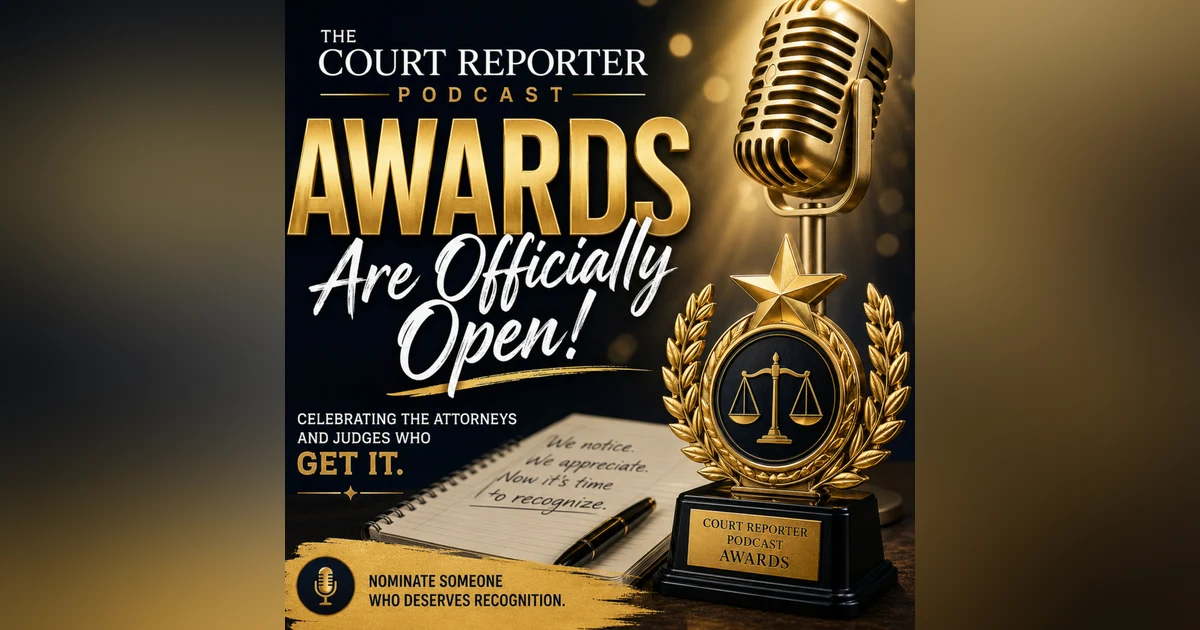


🏆 The Court Reporter Podcast Awards: Nominations Are Open
What makes an attorney unforgettable from a court reporter's perspective?
It's probably not what you think.
In this episode, Brynn officially opens nominations for the first-ever Court Reporter Podcast Awards and reveals some of the surprisingly small things that make a huge impact on the record.
If you've ever worked with an attorney or judge who just "gets it," this episode is for you.
🎙️ Listen now and nominate someone who deserves recognition.
🔗 Nomination Form:
[LINK COMING BY 6/2]
00:00 - Untitled
00:03 - Establishing Order in the Courtroom
03:27 - The Importance of Clarity in Testimony
09:36 - The Importance of Professionalism in Court Reporting
16:36 - Recognizing Professionalism in Court Proceedings
22:28 - Recognizing Professionalism in the Courtroom
26:38 - Opening Nominations for Awards
They say, one speaker at a time. And suddenly there's order. They say, let's make a clear record. And everybody falls in line. The witness slows down, the lawyers calm down.The videographer can finally breathe. We don't know where they came from, but we hope they never leave. Have you ever worked with one? No way. They're real. I saw one once.Medical malpractice case. Three attorneys, two experts. Eight hours. Perfect record. You're making that up. No, I'm not.Some folks treat a deposition like they're hanging with their friends. Half a question, half an answer. Nobody knows where it ends. Talking over one another, looking down and speaking low. You got all that?But every now and then, a legend walks into the room. And suddenly they say, let's make a clear record. And everybody falls in line. The witness slows down, the lawyers calm down.The video can finally breathe. We don't know where they came from, but we hope they never leave. They mark their exhibits before the screen share starts.They know a deposition is in. Improv, theater arts. They state appearances clearly. Every name and every role.And when they joke with opposing counsel, they first say, off the record. Off the record. Off the record. Then when it's time to start again, they say, back on the record. Back on the record. Back on the record.Because they understand exactly why we're here. They say one speaker at a time. And suddenly there's order. They say, let's make a. And everybody falls in line.The witness slows down, the lawyers calm down. The videographer can finally breath. We don't know where they came from, but we hope they never leave. They know this isn't a group chat.They know this isn't coffee with friends. They know this isn't background noise or a conversation that disappears. This is testimony. This is the record. This is history being written.
Speaker BWord by word.
Speaker AWord by word. Word by word. Word by word. When the reporter says, could we slow down? They back us up. When voices overlap, they help restore order.When the witness starts to race, they bring them back. Because excellence isn't loud. Clear. One speaker at a time. One question at a time, One answer at a time. That's how legends are made clear.On the record. Clear. Off the record. Clear. When they're back again. That's how legends are made. The witness slows down, the lawyers calm down.The whole room starts to freeze. We don't know where they came from. But we hope they never. Darling, I've seen one. Me too. Maybe we'll get one tomorrow. Maybe. Maybe. Maybe. Maybe. Maybe.Hello?
Speaker BEveryone, welcome back to another episode of the Court Reporter Podcast. This is Bryn, your host, and today is a very special day because this episode has been six months in the making.Well, not really literally in the making, but I've been waiting to say this for six months because on January 1st of this year, I announced.I don't know how many of you remember this or heard it, but I did announce that on June 1, I would open up the nominations for the Court Reporter Podcast Awards. Nominations are now officially open because today is June 1st, and I did not forget about this. I've been waiting for this day.I've been thinking about it, and I want to explain a little bit about the Court Reporter Podcast awards ceremony that's going to happen. Well, I don't know if it's going to be like a ceremony. We'll see how many nominations come in.And whether it's going to be an event or a virtual thing or just like something announced online or an episode, whatever it is, I just want to make sure that we acknowledge the people in the justice system who make our jobs and our lives easier.The little things that no one really notices except the court reporter, the things that people take for granted but are so meaningful and so important and so often overlooked. So when we work with different attorneys, we notice many different personalities.And it's great that everybody has different personalities, but there are also certain standards that need to be met for the record.And it's really astounding how many attorneys don't know how to follow those things or don't know about them or, like, I don't know, I come to the conclusion sometimes that they don't really teach about making the record with and working with a court reporter in law schools. They don't teach that. They don't go too deep into that. Maybe they mention that court reporters exist.People do take down testimony, but they don't really explain anything from the court reporter's perspective that helps them to understand how to make the record. I don't know if that's true.Well, I mean, I think it's true because I have asked many other people and I've talked to many attorneys and even professors of law schools, even deans of law schools. I mean, Judge Kathy Davidson is one of the judges that came to our International Day of Women Judges event. And she spoke.She was a keynote speaker, and she. I developed a relationship and had many conversations with her, and she was very interested.She is very interested in collaborating so that we can create some of this type of content, educational Content for attorneys to hear from the perspective of those who hold the keys to the record, the guardians of the record, the. The quiet ones at the heart of justice.So I wish that I had the ability to write things down from my brain, just to transmit it to some virtual notebook in the middle of a deposition, because honestly, I do not.The one thing that doesn't work for me that so many other court reporters talk about doing is like making notes inside the record while you're on the record.If you can't take your hands off the machine and you can't take a minute to write something down in a notebook or to write something down in your notes, then when an idea comes to my mind or when I notice something while we're on the record, something, whether it's good or bad, if I notice something, I never get the chance to write it down. So I wish that I had compiled a list of all the things that I've noticed and all the people that I've noticed.And maybe it's the same for other reporters. Maybe you've noticed, but not written them down.So now I'm asking you to start writing them down some way somehow, as soon as your deposition is over, as soon as you get a break, somehow find a way to add to your list the people that do such a good job at maintaining the courteous professionalism in the room.So from off the top of my head, with absolutely no notes to reference or anything, I'm just going to share a few examples of what I think makes a great attorney in terms of the court reporter's perspective and making the record. So, number one, exhibits. I recently spoke to Joshua Edwards and released an episode about this. How there was a.An attorney who asked me to share my screen and share the exhibits on my screen and scroll through the document as he's asking the witnesses questions. I mean, as he's asking the witness questions, I would be the one scrolling and managing the screen share. And that experience was so unfortunate.It was just so uncomfortable. I didn't like it at all. I felt very stressed out the whole time because I was trying to like.Anyway, I told them, okay, if I'm doing this, then I'm not. We're not on the record.If you're talking about the exhibit and I'm scrolling and you're asking me to scroll, we are not going to be on the record while I'm doing that because I can't take my hands off of the machine. I can't do that. I don't like to do that's just not professional for the attorneys to. I mean, it's not that it's not professional.It's not their fault. They didn't know. They didn't learn it in school. They didn't know about remote technicians. They didn't know about all that stuff. So that's fine.That's the purpose of these awards. But one example of an award winner could be someone who always prepares the exhibits ahead of time. So the exhibits are organized.They're not shuffling through and trying to figure out what page or what exhibit each thing is. They already have it clearly marked and ordered beforehand. Even though I'm the one officially marking the exhibits.They already know exactly what it is and where it is, and they don't waste any time on the record trying to fumble through those documents. So preparation. Court reporters notice. We notice when you're prepared. We notice when they're not prepared.And if they do their own screen shares, that's extra bonus points. If they hire a remote technician for that, that's good too.But I think it's nice for them to be able to scroll and do their own scrolling and their own screen share because most attorneys should be pretty literate when it comes to technology, at least in 2026. And same goes for court reporters. I'm not saying we're off the hook. We are pretty good at tech, too. We have to be.But we, as stenographers, we're not the ones that should be sharing screen and scrolling through the documents on the record. Okay.So court reporters, if you notice attorneys that are always super prepared and you notice it like above all others, and you just notice someone really stands out for preparation, that's one thing that we should recognize and we should celebrate so that attorneys can know. Wow. Court reporters really notice these things. We notice everything.Another thing we can also tell is how much preparation they put into the witness preparing the witness.We can tell by the way that the attorney interjects and interrupts to remind the witness how much they really prepared and tried to get the witness to understand ahead of time the purpose of the proceeding and the purpose of my being at the proceeding. So another. That's another one that falls under the category of preparation.When the witness is super prepared and the attorney makes the effort to continue to remind the witness and try to maintain order of the proceeding. And that leads into. The next thing that comes to the top of my head is not treating the proceeding as like a casual conversation.I feel like that's so common nowadays. Everybody wants to just be Comfortable and be casual.Treat it like a college dorm room hangout session where they're just like talking to your friends. But they, But a deposition should be treated as a formal proceeding.You should understand that it is not a regular conversation where you can just cut in and out and cut each other off. Half a question, half an answer, that is not, that's not really good. It's not helpful for the court reporter and it doesn't make a good record.And then some of them even have the nerve to complain and that the record looks messed up because. But I mean the record can only be as good as the ones who are making the record.We are not making the record, we are just writing it down exactly as it's presented to us. That is what we are supposed to do. So all that other stuff kind of is on the attorneys to make sure that they speak clearly.And if they don't want their questions to be half jumbled and dashes everywhere, then they should really prepare the witnesses. I mean, I understand that the taking attorney does not have the opportunity to prepare the other counsel's witness. So that's not their fault.I'm just saying you can tell with the opposing counsel at least if they prepared the witness very well or if they did not. And then with the taking accounts, with the taking attorney, the one who's asking the questions.One thing that I kind of don't really like is when they start every question with alright or right or sure or okay or, or even worse, they repeat the answer that the witness said and then they ask their next question. That to me, that just looks so weird in the transcript and I don't know how that reads when they get it back.So attorneys who really make it a formal proceeding and don't add too many filler words and really show that they did their homework and that they really prepared and they keep things moving along. They don't spend a few minutes in between each question looking at their notes or writing things down.They don't try to write things the record down themselves because they know that that's what we are there for. Even better is the attorneys who hire real time reporters.They understand the value of seeing the record coming up clear and clean in real time on the spot, in front of their, in front, right in front of them. So they don't have to argue about what was said.They don't have to make me go scrolling back to find an answer or a question that they want me to read back. They already have the real time feed right in front of them so the record can stay clean.So overall, these awards are all about recognizing the people who quietly demonstrate that courteous professionalism in ways that go unnoticed by everyone except us, except the people creating the record and writing down every word. Most attorneys don't notice. They don't know how much court reporters actually notice.We notice when an attorney takes the time to identify clearly what an exhibit is on the record.I've noticed a pattern where so many attorneys just are so casual about the proceeding that they just think, oh, I don't need to identify this on the record. It's just going to be somehow on the record. Like, I'm just going to write it down.Even though they didn't say it, they have to understand we are there to write down what is spoken, what is verbally presented in a word out loud, not just, like, interpreting what's going on in the room. We don't do that. We do record the record. So there was a deposition I recently had where the attorney would, like, she would have me mark the exhibit.She would just hand it to me without saying a word, expecting me to just know what exhibit we're on. So then I, for the sake of the record, I would say it out, say it out loud to confirm with her, okay, I'm marking exhibit 12.And I wouldn't put myself in the record like the court reporter said, I'm marking exhibit 12. No, of course not. I just want the words to be spoken out loud so that they can be.It can be clearly written down on the record that this is what's happening. So because the thing is, like, we have this software, and in the moment, we're writing down what is spoken.When an exhibit is marked, we also have a stroke that we write, mark, mark, or whatever it is for you. We write that stroke, and it lets us fill it in later what the exhibit is.But if the attorney says it out loud and identifies it out loud at that moment, that means it makes it so much easier for us to fill in that information later. It saves us so much time.So during that deposition, I would sometimes try to, like, say it out loud because I noticed that she would just hand it to me silently. Then I would write. I would mark it down and hand it to the witness, and then she would just start asking her questions.So when I started catching on to that, that she's not actually stating what the exhibit is, she's not even. Sometimes she would ask the witness, okay, please identify what this is for me. And then the witness wouldn't know what it is.And then they would go in circles and the exhibit would not be identified on the record. So when I realized that this is the pattern, I started to try to say it out loud to catch so that the record could catch what. What is being marked.So to summarize that, we notice when an attorney clearly doesn't just say, let's mark this as Exhibit 12, or doesn't say nothing like that other attorney that I just was referring to in my recent deposition, but instead they say, let's mark as Exhibit 12, the March 3, 2024, email from John Smith regarding the roof inspection.Okay, that little detail makes such a big difference, stating what was marked for the record, what the number or the letter was, and what the title of the document is. Just trust me. It makes it so much easier for our auto indexing.Now let's talk about when a witness is indicating something with their hands, they're pointing to a body part, or they're, you know, doing something to indicate something, and it's not stated in words. A good attorney that court reporters love will say, let the record reflect that the witness is pointing to his left shoulder.And, you know, whatever it is, whatever that's happening, if the, if the attorneys want it on the record, they must say it out loud. It's not going to automatically be captured.So I guess overall what we're talking about is record conscious attorneys, the attorneys that are really conscious of making the record.Because there are a lot that just totally forget the purpose of what we're doing, it seems, at least we also notice when they clearly state their appearances and note when someone else enters the room. If that person is someone that they recognize, they will state for the record that that person has entered the room.It makes it so much easier for us to note that for the record later on. Otherwise, there's a chance that it may never be reflected who else was in the room, if it was never spoken out loud.Like if someone entered in the middle of a proceeding, in the courtroom or in the deposition, virtual courtroom or the zoom room, and no one says anything, it may not get on the. And here's the funniest thing. Most of these things, and the thing is that most of these are not flashy.No one's getting a standing ovation for clearly identifying an exhibit. They're just doing what they're supposed to do.No one's going viral on LinkedIn because they remembered to say off the record and wait for agreement from the other opposing counsel. No one really gets acknowledged for that.But those small Acts of professionalism really do make a difference, and we do want to acknowledge those things. So I think they deserve to be recognized. So what exactly are these awards?They're designed to recognize attorneys and judges who demonstrate exceptional professionalism, courtesy, preparation, respect, and leadership in the courtroom and the deposition room. And it's not that they're famous. It's not the people who are the loudest in the industry.It's not the ones who are making the biggest innovative changes. It's not the ones who are gathering a huge following online. It's not the ones who have major titles, who have impressive titles and credentials.It's not the ones who are advancing the technology. No, it's not. It's because they consistently create an environment where there's clarity and they are so courteous and professional.The people who make everyone around them better, who just make the record go. The people who. These people are probably either judges or going to be judges in the future.The attorneys that really exemplify professionalism, and they understand that courtesy is not a weakness, but it is something that is so, so attractive to us court reporters. Courtesy creates clarity, and clarity creates a better record. Okay, so now let's talk about the nominations.Nominations are open beginning today, June 1st, and they will remain open for the next six months. That gives everyone plenty of time to think about the attorneys and the judges who truly deserve recognition.I don't want people rushing through this or just like, deciding in the moment. I want to. I want you to have some time to notice the patterns. I want thoughtful nominations. I want stories. I want examples.I want to know what this person actually does that stands out from the rest of the crowd. Tell me about the attorney who always backs up the court reporter. Tell me about the judge who always protects the record.There was one judge in, I think it was in. Yeah, Bronx Supreme Court Judge Tuit was her name.She would always, always walk into the room and address the court reporter before addressing anyone else. It really showed how much she respected and valued her court reporters. So, yeah, tell me about that.Tell me about the attorney who prepares witnesses exceptionally well. Tell me about the attorney who brings professionalism into every room that they enter.Tell me about the one who quietly raises the standard, because those are the exact people that we're looking for. And here's something else that's very important, too. Every nomination will be personally reviewed. Every single one.I'm going to read all of them, and I will evaluate them. I will reach out.Depending on the nomination, I may reach out to references, colleagues, court Reporters, attorneys, judges, or other people who have first hand experience working with the nominee. Why? Because I want these awards to mean something. I want them to have credibility.I want recipients to know that they were selected because people genuinely respect how they conduct themselves, not because they're popular. This is not a popularity contest. Now, some of you may be wondering, can I nominate someone I've worked with? Absolutely.That's exactly what I'm asking you to do. Notice the things while you're working with these people. Can I nominate a judge? Yes, absolutely. Can I nominate an attorney? Yes.That's who these awards are for. Can I nominate someone who's not famous? Yes, please do.In fact, those are the people that I am most interested hearing about, because some of the best professionals in our industry are the people whose names are most that most of us have never heard before. Yet they consistently demonstrate excellence every single day. And that is worth celebrating.One of the things I've learned from hosting this podcast is that our profession spends a lot of time talking about problems, myself included. And I'm sorry for that, but it's understandable with, you know, with what we go through and every profession, every profession has problems.But I also think it's important to talk about what's going right, to recognize the people who inspire us to celebrate professionalism, integrity, preparation, courtesy, excellence. And that's what these awards are all about. So today, nominations are officially open. Think about the attorneys, think about the judges.Think about the professionals who have impressed you, the people who made your job easier, the people who respected the process, the people who quietly set the standard and send me their names. Not just their names, but I'm gonna put a form, we are gonna create a form for the nomination process. You can find that in the show notes.So thank you for listening and as always, thank you for everything you do to protect the record. And I'll see you next time.


