#34 - Transforming the Justice System with Rachel Artis in Nigeria


Imagine a legal system where the court reporters are nowhere to be found, leaving judges to try to keep an official record of the proceedings with their own notes, or worse, completely by memory – a reality that is all too common in places like Nigeria.
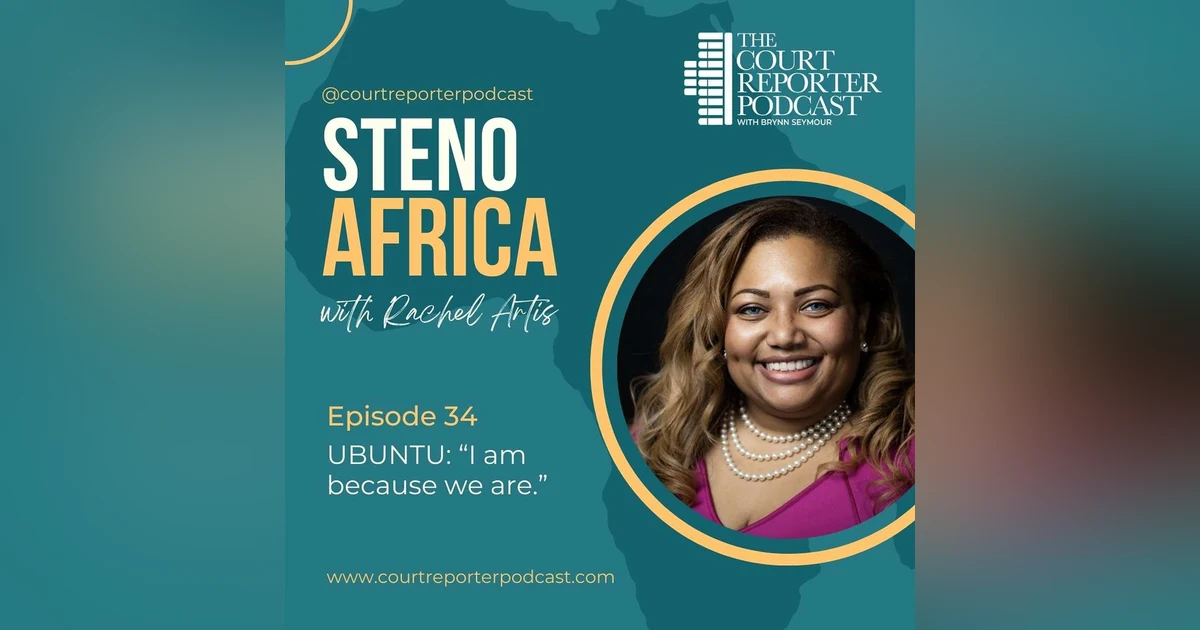
This episode spotlights Rachel Artis, a visionary entrepreneur currently in Nigeria advocating for justice and implementing court reporting programs.
We take some time to delve into the cultural embrace and recognition that comes with working to strengthen justice in Nigeria. You'll even learn a few African phrases and words like Ubuntu – a selfless philosophy that emphasizes community and shared humanity. Join us for this compelling story of commitment, community, and the slow, steady march toward revolutionizing an entire court system.
0:01 Welcome to the Court Reporter podcast. Hi, my name is Brynn Reynolds Seymour. I'm a certified life coach, former freelance court reporter and currently working in the court system. For years, I lived in constant overwhelm, drowning in pages, deadlines and self-doubt, feeling like I'm not even qualified to be doing the important work I'm doing. Despite my best efforts to carve out time for other activities in my life, work always seemed to find a way into the back of my mind and weigh me down so that I couldn't really enjoy those other moments. If you've ever felt like this, you're not alone and it doesn't have to be this way. In each episode, I'll dive deep into the challenges we face in our daily lives and share practical coaching tools and solutions to help you reclaim your peace of mind and become the most confident person in the courtroom.
0:41 Hello, so we have some exciting news. There is now a new website courtreporterpodcast. com. www. courtreporterpodcast. com. This website is now live. You can sign up for our newsletter there. You can also leave comments and voice messages on episodes. So please do engage and share your thoughts. I really want this to be a place for everyone's voice to be heard, so if you have something to share, please contribute leaving your comment on courtreporterpodcast. com. Let's just take a second to imagine a justice system without court reporters. So here's a scenario. In a high-profile criminal trial, Judge Smith (that's a made-up name) presides over a courtroom packed with attorneys, witnesses and spectators.
1:27 The case involves multiple defendants, intricate legal arguments and emotionally charged testimony. As the trial unfolds, Judge Smith decides to take notes in an attempt to keep track of key points and evidence since there is no court reporter. However, as the proceedings intensify, the judge finds it increasingly difficult to juggle note-taking with managing objections, issuing rulings and maintaining the order in the courtroom. Despite his best efforts, Judge Smith struggles to capture every important detail amidst the fast-paced dialogue and legal nuances. Frustrated and overwhelmed, the judge begins to miss crucial pieces of testimony and fails to record critical objections raised by the attorneys.
2:09 As the trial progresses, inaccuracies and omissions in the judge's notes become very apparent, leading to disputes between opposing counsel and challenges to the accuracy of the record. So, without a reliable transcript prepared by a trained court reporter, the integrity of the trial and the integrity of the record is called into question, jeopardizing the fairness of the proceedings and the rights of the defendants and the plaintiffs and every party in the case. Okay, so in this example, the importance of everyone focusing on their own role becomes evident. While judges are essential for overseeing proceedings and making legal determinations, making difficult decisions, attempting to fulfill the role of a court reporter when they have to do that can compromise the integrity of the judicial process.
2:55 By allowing each participant to focus on their specialized tasks, such as presiding over the trial for the judge or producing an accurate transcript for the court reporter, then the legal system can function more effectively, ensuring that justice is served. So through this example, you can see and understand how important court reporters are in the justice system and what chaos and what injustice would be served without us. So going to talk talk about this topic today, because this is actually a reality in countries like Nigeria. So let's welcome Rachel Artis, who is currently in Nigeria.
3:35 Rachel Artis is a dynamic entrepreneur with a profound impact on the court reporting industry. She got her start as a court reporting student in her home state of New Jersey. With over 14 years of experience as a scopist, she has not only built a thriving scoping and proofreading agency, but also co-founded an online scoping school after personally training over 250 individuals as scopists. Scopists are editors for court reporters for anyone who's not familiar with the term. Rachel started consulting internationally almost immediately through her passion for giving people opportunities, regardless of their location. Rachel's journey transcends traditional boundaries, as she currently works to revolutionize Nigeria's judicial system, empower its citizens and memorialize the nation's history and current affairs with captioning in the entertainment and media sectors.
4:23 Okay, so welcome Rachel Artis. Thank you, thank you. I'm glad to be here. I am really excited to talk about Nigeria's justice system and the importance of advocating for court reporting in the nations and the countries that are not currently using court reporters. I was very surprised to hear that in Nigeria and probably a few other countries, they're actually not using court reporters and the judges are trying to play the role of a court reporter and they're actually taking, you said longhand notes? Yeah, not even shorthand notes. Not even shorthand. And they're trying to fulfill the role of a court reporter, which is a very important role in the justice system.
5:07 But they also have to make decisions, manage objections, like they have a role. They're the judge, they're also trying to be the court reporter. So how is that working out? You know, I think it has served Nigeria and other countries on the continent, you know, and even some of the outlying islands, but I think they're ready for justice in a more should I say, speedier way, more, you know, expeditiously getting accomplished. Because a lot of the judges are getting up in age, I think we can all just kind of brainstorm four or five critical things that may go wrong.
5:49 If a judge is writing longhand, that means cases don't get complete. There's trials that go on for decades just because there are adjournments. And if a judge is writing, if we think of ourselves having to be a judge and write down every day what's going on in the case and then make decisions about that for a career, let's say, 20, 30 years, a lot of judges retire in their 60s or 70s. So that's some of the challenges they have and I think they're ready for court reporting the way that we have experienced it in the West.
6:31 Absolutely. The justice system definitely needs court reporters and a judge cannot play the role of a court reporter. Like, absolutely, like you said we could think of. I mean so many things could go wrong in that situation. Yeah, and they do and I think that because they're so used to it, it's not really first on the mind of some of the issues that people are facing can be reduced or eliminated just by having a court reporter. Yeah, absolutely. Our role is essential in the justice system. So so what motivated you to take on this project of advocating for court reporters in the justice system?
7:20 Like, how did you get into this? So? I like to say that I came into this kicking and screaming. It wasn't really my bright idea, as my mom says, sometimes it wasn't my bright idea, but what happened was during this is probably back in 2015, I started seeing African names pop up in different court reporting Facebook Facebook groups that I was in and what I noticed is that, just as I was feeling proficient and scoping at that time because I was kind of still getting my feet wet, still getting started no one was answering their questions and it was kind of weird like are they bots?
8:00 Are they trying to scam? You know, because at that time we had a lot of people trying to come into court reporting groups and the administrators were trying to protect the reason that we were there, which was to educate ourselves as court reporter professionals in the industry and things like that. And so I just out of curiosity said hey, what's up? Who are you? What are you doing? Nice to meet you. And that conversation just led to a relationship with different court reporters in Nigeria and when the pandemic started, one of their major courthouses burned down and I instantly remembered those conversations that I had and was just thinking like wait a minute, are they okay? What happened and when I went to check in, we just kind of had longer conversations I guess you can say that I had had before and I started training them how to scope and I decided I wanted to come into Nigeria and meet them in person, because that was also during the pandemic time period, so they were kind of like on furlough.
8:53 They weren't getting their salaries during that time and you know, the whole world was basically shut down at that time. So I tried to empower them through teaching them how to scope, and that really meant a lot to me personally and I promised myself and them that when everything was over and everything had calmed down, I would come down and visit them. And that visit turned into them begging me to do a one day training at the court and I didn't really see the point, to be honest. I was like I came here to see you guys. You know I came here to meet you guys and the chief judge of Lagos State was kind enough to allow me to do a one day training, ask for a report about my findings and then, after I gave him my report and listed the issues that I saw with the system that they currently had, he then asked me okay, well, how would you fix it?
9:44 Send me a proposal and, as they say, the rest is history. So and what did that proposal say? Like, what did it? What does that look like? Yeah, so really I had to take a good look at what was going on. So these court reporters had been trained all the way back from like 2012. They were trained to about 110 words per minute, some of them, and then sent out into the field. So there were technology issues. Their systems were outdated. They were using writers that I had never heard of at that time. That made their job more difficult because of the logistics issues here in Nigeria. By the way, I'm personally physically in Nigeria right now.
10:26 I wasn't talking to you but so that's why I'm saying here but the logistics are, and you might have heard that loud click in the background power. Power goes on and off every day, like a water faucet almost. So that really affects how they're able to take the record down. So the writer they were using was connected to a laptop and did not have a screen. So when power goes out, they're blind, basically. So those are some of the things I suggested newer equipment, writers that had screens on them, and training on their software, training on how to be a professional. One of the real challenges is that they are employed directly by the state and when they work with a judge, they follow that judge their whole career, so they actually become like a personal secretary to the judge, if I could try to describe that relationship.
11:21 So that also creates a lot of conflict. You don't really have a bipartisan court reporter at that point. They're not neutral. So I also talked about some of those things in my proposal and he was really forward thinking enough, I think, and took a risk to be innovative to what that process looks like, and he agreed that. You know, I never thought of these things and of course he himself has a court reporter. So that's kind of what some of the things that I had in the proposal. Okay, so let me get this straight. I think so. They do use court reporters, but you're trying to improve the system, the court reporting system, because my understanding was that they don't use court reporters, but I guess some of them do, so one state.
12:04 Yeah, so one state is fully integrated with court reporters in Nigeria, but only some of the judges use them, and when I say use them, I mean utilize that service. Quite a few of the judges that I've met still write longhand while the court reporter's writing, because they haven't built that trust. So that's one element. Then you also have magistrate court and they don't have court reporters at all. So, even though court reporting is present in the whole state of Lagos, being that there is a court reporter to the honorable justices in all of the courthouses, they're not really utilizing them well and I really haven't been trained to have that relationship with the judge specifically for that.
12:49 Some judges like them and use them as a court reporter, like you would see in the United States, and some don't. Now, and other states that I've now kind of branched into having these conversations with, they do not have stenographers at all. Wow. So maybe, like one of the court reporters from Lagos decided to move and somehow, through word of mouth, this one judge was like I really want this person, I want this court reporter, and they have them, but as far as system wide, even at a federal level, they don't have court reporters. There are a few here and there, but they're just sprinkled throughout the country and a lot of the school.
13:33 That was around a while ago, I think. The instructor passed away, unfortunately, so there really hasn't been a passing on the torch, so to speak, in Lagos state and also at the federal level. So there was like once upon a time, I think, there were a few reporters at the House of Assembly. Then they retired and again, they haven't trained. That I'm aware of. They have not trained court reporters in Nigeria since around 2016. That was the last graduating class, if you will. So you can imagine people moved away, people move on, people retire, and so it's not nowhere near enough. And they are only trained to. They only have to pass 110 words per minute.
14:14 Yes, that's what I've been told. They only had to pass at about 110 words per minute. And the other challenge for them is that they were taught American English court reporting, which is really challenging because Nigeria and most of Africa, I would say even their legal system is British influenced. So that also affects the English that they use and the spellings that they use. And then, of course, they have their own languages that they speak. Nigeria has quite a few different tribes and languages and they're very, very diverse, so it's not unheard of to have two or three languages going at one time on, you know, a trial, and actually some of the court reporters are interpreters as well.
15:00 They will literally stop writing, interpret and then go back to writing. So everybody's doing several jobs at once, and so it's definitely a multifaceted opportunity. But challenge is the word that comes to mind first. That doesn't sound very productive for everybody to be playing all the different roles and I never knew this, you know, I just thought, I just I think we all take it for granted, coming from the states, that like, oh, everybody is doing the same thing, and right, it's not happening that way. Did we talk about Steno Africa yet? No, we haven't. Okay, what is Steno Africa?
15:40 So Steno Africa is a project that I started really because when my clients, my friends in the court reporting industry, learned that I was kind of out here in Nigeria for the long haul doing this work, they really kind of got behind the calls with me and really wanted to know how they could support and I think that was supporting me and my stay here. Because, you know, being an expat when you weren't prepared to be an expat has a lot of strange challenges that come with it, and then also an expat. So expat is like it's short for expatriate. So I am, you know, an American citizen, born and raised in the US, and then when you went to go and be outside of the country longer than like vacation time period, where you're like working there or you're just going in and out of other countries and, you know, working remotely just outside of your own country, they call you an expatriate and they've kind of shorned into expat.
16:41 So that is what I mean by that. And then they also wanted to support the court reporters, because the reason that I came to Nigeria was really to support court reporters that had been forgotten about here in Nigeria. And so when they learned that these court reporters make an average of between 80 and $120 per month US if I'm converting it to be full time official court reporters. They want to know how they could support and so we set up this project and our goal is to become a 501C3 this year, but right now it's just a project where court reporters can donate equipment, software helps and funds to support education that I may want to give the court reporters that their court is not ready to support, so maybe I want to really spend more time with them on software, but that's not in the curriculum that I'm able to teach them right now.
17:46 So we may create a retreat and, like last year, we got a lot of support. We had a what we called Steno Africa Beach Day. Beach was spelled in English and then day was spelled in Steno and we took all the court reported out to the beach and we had barbecue and we all had matching African print fabric which is called Ankara. That was like the fabric of the day. Everybody had shorts made and different little outfits made to be on the beach and it was really just a way to create community and celebrate the court reporters that really felt and do feel overlooked because there's not a court reporter job title in Nigeria, so a lot of the perks or benefits that they would get and should get for this amazing skill that they have, they're overlooked.
18:36 So Steno Africa is a project that allows people, even companies that have firms and other brand partners that donate so that we can have events, we can hold classes and training and we can offer financial support to some of the court reporters that may be in need and just really support the effort that I'm doing here in Nigeria and Africa. That's amazing, you know. It just made me think of the United Nations. Have you reached out to the United Nations or gotten their support at all? Because what you're doing is helping promote sustainable development goals 16, peace, justice and strong institutions, which is basically providing access to justice for all and building effective, accountable and inclusive institutions at all levels.
19:18 So it sounds like what you're doing is in line with what the United Nations is trying to accomplish through SDG 16. It's funny. You should say that because I have not. I do not have a relationship with them as of yet, but through my networking being here, I was invited to the Universal Periodic Review for the states in that surround Lagos, inclusive of Lagos, and I was invited by just someone I had met at a attorney's dinner. And when I was invited to that, then someone I met there invited me to that and just said, hey, come, and I had no idea what it was for, what it was about. But yes, the effort that I'm doing actually ticked about 20 different adopted line items that the Universal Periodic Review requested Nigeria to act on and that effort is supporting them.
20:13 So I was able to write a letter or report and show how my efforts are supporting things that other nations asked Nigeria to do and Nigeria agreed to do over the past four years. So I do look forward to maybe having those conversations and networking in the future, because that is what I'm doing and I didn't know that there was agendas and missions and things like that out there for this effort and for what I'm doing and I have really tried to focus on what that task is and not be distracted, and one of the ways I've done that is by staying self-funded and not taking on investors. The way that I support that is just by scoping and proofreading in my apartment here in Nigeria, so that I can feel good about the decisions that I am making and sleep easy at night, knowing that I don't have someone else's agenda that I'm necessarily pushing and that if I want to walk away from a situation, I can, and that's really, really important to me.
21:18 I would love to have that conversation and find out more about those things, but I've slowly become aware that, yes, my mission and what I'm doing does align with some of those efforts that the United Nations has. Yeah, because Whenever we team up with other organizations and partner, like even their sustainable development goals, there are 17 goals that address the needs of the global issues. Okay, number 16 is the one about justice and the number 17 is partnership for the goals by partnering up with people like the United Nations, or organizations, courthouses and things like that. But you're fulfilling. Yeah, I'll have to look into that, yeah.
21:58 Definitely, because that's an important global issue. So that's really amazing. You probably experienced a lot of hardships, and it's not easy to live in Africa. Even you were telling me earlier we were experiencing some internet issues. It's probably unstable. Then the court reporters also lose power. Then what gives you the strength and the motivation to continue and stay committed and remain in Africa, even though it's probably hard? Like what kind of hardships have you experienced? Sorry, that was like three times yeah. I'm not an object to answer. I do that all the time. I'm looking for like a yeah, so do I?
22:38 Yeah, I can give you a summary. So you're filling the hardships. The main hardship is that I came here to visit, so I have a visitor visa. I am not an employee, so I don't qualify for a work visa. Okay, I have to exit and re-enter the country every 30 days, sometimes less. So that is just a financial hardship, a logistic hardship, to know which borders are safe for me to cross, because it's expensive to fly in and out of countries every 30 days, yeah. And the next hardship is the cultural hardship I don't want to say the culture shock, because I have visited other countries, lived in other countries before, but this is a little bit more close to home because I am a black girl from New Jersey.
23:25 So when I came to Nigeria or Africa and everyone's perception of who I am as a person is not the perception that I have had of myself all my life, it's really strange. So I went from what I would consider I lived in South Carolina before I moved to Nigeria. I went from living in a small county outside of Myrtle Beach just blending in, to now being everyone's focal point. That's like a blessing and a curse, if you will Like. I look at it as that it's hard to navigate. At home. I can jump in my car and go to TJ Maxx if I want to, but anytime I want to move around, do something, I have to move with a certain amount of security and a certain amount of caution and a certain amount of planning.
24:12 That goes into everything that I do, and the more popular, the more well-known I become. That security has to go up. So that's challenging, going from being a middle class American to being thrust into this kind of class of first class and not how I was at all raised and nothing that I understand. It is strange and it can be a bit isolating, lonely and, if I'm not careful, depressing, because I have to be careful about who I trust and friends and I'm a really open. If you know me in person, I'm really open down to earth.
24:52 We can hang out. I never meet a stranger and that's just not necessarily smart. Being autistic and having ADHD and learning the rules of a new culture is really, really hard, and so that's a challenge. That's one of the hardships. And then the other hardship is the currency. If you know anything about the Nigerian Naira, it fluctuates. It's at such a fast pace and all the time that you really can't predict your expenses. So there's really no such thing as budgeting in Nigeria, because, even if you are gainfully employed, what bought you groceries for two weeks can quickly only buy you groceries for two days, depending on how fast the currency moves, and you can't necessarily prepare for that or anticipate what that might look like unless you want to start studying financial markets or something which I don't have time to do.
25:50 So that's really hard because it's hard to plan, it's hard to grow a business, it's hard to do anything you really need to do that way. But all of those hardships is actually the main reason I think that I am passionate and committed to seeing this through, whatever that looks like, because I think I mentioned earlier, I really did not necessarily want to come here and do this. This wasn't my goal. I didn't wake up with this vision one day and say I'm going to go to Nigeria and revolutionize stenography over there. So what I learned while I was here is that, because of the color of my skin, the fact that I'm an American and the fact that I am exposed to court reporting and international standards of record keeping, I can get indoors that a Nigerian court reporter cannot get into Even an Nigerian business person that sees the wisdom and has heard about it and wants to push this effort.
26:51 They're just not going to be given that shot and it's unfortunate but it's true. And once I came to grips with that and realized the privilege that that afforded me, there really is no person that I can say I want a meeting with you and I won't get that meeting. And not only get that meeting, but then get a call back and get a request for a proposal and things start moving ahead, which I thought that was normal, because I think in America we're used to getting a response most of the time for something that we're trying to do. We're not used to our efforts kind of just for years and years, decades or a lifetime being ignored. We might not get hired for a job okay, six months, maybe a year for the one that we want, but we have so much opportunity in the United States that we just we take it as a given that hard work pays off and I've learned here that's not true.
27:48 Someone can be passionate about something, but if they don't have something that either the government or the court or their people respect, it's just not gonna move ahead. And I feel like it would be pretty selfish of me to understand that and walk away. You see the problem, you have the solution, so you're stuck. It's like you were appointed, yes, and like you can't really get out of it without you know you're going against your conscience because you know the power that you have and what you can make happen, and you're the only one that can do it, which makes you like the appointed and the one, the one that has to do it.
28:31 Yes, so that's why I'm committed. It's funny you said that one of the administrative judges, which is like the second judge to the honorable chief judge of Lagos State, she gave me a Yoruba name in November. She already gave me one before, but she gave me one in November and that name is Omowale and that means our daughter has come home. Wow. And I don't even know why I'm getting. I'm starting to get choked up, saying like when I say those words, because I know what that means to them, you know. And after she gave me that name, after a presentation that I gave, you know, everyone in the whole court system started calling me that. And it's touching because the first name that she gave me, which is about six months prior, was Ebunolua, which means a gift from God, and when I gave my last presentation, she said you're no longer a gift from God, you're our daughter and, yeah, you can't go home after that, you know.
29:31 So to know that the work that I'm doing has such an impact is very humbling and it's something that I think I'm gonna be proud that people will know that about. You know what I've done in this career. I didn't start out as a court reporter. I was a student. I became a scopus because my schools kept closing down and I was just happy to be in the industry, you know, just happy to be a part of something that you know what I didn't know at the time that I was autistic and had ADHD, that I kept failing at every career I tried. I was just happy that I stayed and people wanted me to be there, you know.
30:14 And so to now know that I'm over here and doing something that I don't think anybody in our industry would have even thought of. You know, I sure didn't that existed, and having so much work ahead of me. One of my really good friends I call her my auntie in the court reporting industry, angela Grant, out of New York she just said just put one. I call. I said what am I supposed to do with this? I mean it's massive. And she said just put one foot in front of the other. And it sounds so simple, but it takes a lot of courage to put one foot in front of the other when what you're staring down is massive. I hope I do it justice. Wow, that's incredible. You have an amazing story to share.
30:56 It's newsworthy and an important mission that you've been called for and you can't turn your back on it now. I guess that's how you feel, and that's really amazing. You know, one of the sayings that I think originated in Africa is Ubuntu, and I always love that. Have you heard that one? What does that mean? I haven't heard that one. Oh, ubuntu it's. So it basically means like I am because we are. It's an ancient African word meaning humanity to others. It is often described as reminding us that I am because of who we all are. But I remember there was a story that illustrated the term Ubuntu and how, in African culture, there was a group of children and, like this scenario, illustrated their culture, I guess, and their unity.
31:48 I love that. I love that it's true. It's so true because our culture, what I've learned as an American living in Nigeria, is that we are a very self-centered culture, for better or worse. That does give us opportunities and it does give us a perspective that I think contributes to a lot of the successes that we have. But Africa is more communal. There is no. I Do you know what I mean? Yeah, and so learning that culture and where I lacked as a human being, as a person, where I had room for growth, has really helped me to grow as a person and not focus on myself so much.
32:28 The way. I didn't realize that to most people in the rest of the world. I guess I was pretty selfish. You know that I did things that I wanted to do because that's what I felt like doing. You know I didn't really have so much thoughts toward. You know I helped people. I did what I thought was right. I did what I thought was fair. And most people would say you know I'm a generous person at heart. You know I try to help others and I've always done that. But living in Africa takes it to a whole another level and learning how to fit that in, because some people here are so selfless, it's like when do you have time for yourself, when are you going to make something about yourself?
33:08 And they kind of look at me like what are you talking about? It just doesn't even cross their mind. And I know there's a lot that I, you know, like, as an American, learn just from my worldview, my perspective, where I had to check myself, you know, and it helped me to grow. It solved problems that I had. The rates that we have in America, maybe drug use or suicide or just things that are occurrences because we are so focused on ourselves you don't even realize if we just stopped focusing on ourselves long enough, we would eradicate a lot of our own problems, and that's what being here in Nigeria has taught me to be more communal. Yeah, I found. I just looked it up and found the story Okay.
33:48 So it's so cute. It's like. This illustrates it exactly. So an anthropologist proposed a game to children in an African tribe. He put a basket of fruit near a tree and he told the children to whoever got there first would win the sweet fruits and they could have it all to themselves. So when he gave them the signal, he told them like ready, set, go. But instead of racing, they all took each other's hands and ran together, and then they sat around the basket enjoying the strawberries together. Wow. And so I think, like upon being questioned about like why did they do that? Why didn't they try to get it for themselves, like, as the mentality in the West would be probably?
34:29 to try to get it for themselves. They, you know it was because they view it as their one, their together, and I am because we are so. I thought that was so beautiful. It's a beautiful testament to really how they are. Like something simple I'm not gonna say sorry as an American unless I intentionally did something to you and I agree that I intentionally did something to you Right In Nigeria. If you cough, someone says sorry. So like if you coughed right now out of habit, now I would say sorry and you're gonna say, oh no, you didn't do anything.
35:10 You know we're almost offended at someone saying sorry unnecessarily in our culture, right, but here, like if I stubbed my toe, oh sorry, and they're like, they're instantly concerned, oh, you know, and so that's just something. That's small, but you see how it's like woven through everything that you could be in public. It's perfect. Stranger they don't say God bless you if you sneeze, they say sorry. And you know, at first it was weird, but you actually, like I actually started feeling comforted by it. Like someone is actually looking over me at all times. You know there's not.
35:50 You know I tell them stories about things that happened in America. They're like that would never happen here. Like we hear stories sometimes on the news about maybe how someone passed away and they were in the house with family in their room and no one knew they'd passed away, maybe for days. Then they'd say how does that happen? It's impossible that no one leaves you alone. For better or worse, you are never left alone. You know it's they. Just they don't do that. If you don't eat like they, everyone's asking. I get asked at least 15 times a day if I've eaten and I'm glad because I have ADHD and I forget to eat. But they ask me all the time. It's all the time oh, have you eaten?
36:30 And it's like at first I was offended, like what does that mean? Why are you asking me if I? ate? So what if the answers no? Do they offer food, or like they're just well, first of, all they're offended. They are like, it's like you did, it was a personal affront to them. Like I was telling my personal assistant yesterday, that was this Thursday, she's like, did you eat? I said no, she's like why? Like it was very later, instantly, was you know? And then she just she went and made me food. You know, she just went and cooked. You have a personal assistant, like with you in person. I do, yes, so that's another thing that I will say this.
37:10 The other reason that I can do this is because which I wish we had this in the States but the service industry is like alive and well as far as like maids and cooks and personal assistants and drivers, and so I'm able to have a team that allows me to stay, because I can focus on the work. But if I was in America, I probably would not be able to. The average American cannot afford that kind of help. I literally just get to work on my projects scope, proofread and rest. That's it, because everything else is done for me. So it's like more affordable there.
37:50 Yes, absolutely, it's more affordable. I would say total. Everyone gets paid once a month. Payroll last month for Nigeria was around $250 US total. Oh wow, and that's for a personal assistant, project manager, a driver, a cook and a maid. What? Yeah that's, wow that's. Yeah. It's wonderful, yeah, so that I don't think I would be. Well, it's not, I don't think I would not. Yeah, I would not be able to do this. So that's the other reason it's kind of hard to leave because I can get more accomplished. So there's obstacles, yes, but I can actually get stuff done, you know, because I get to brainstorm and troubleshoot and figure out solutions and really like wrestle with a problem or something I wanna deal with because I don't have to run on to the next thing.
38:49 So it's definitely, it's a culture shock in that way, because my life is totally how I live in Nigeria is how we would like imagine, like I don't know, like Jeff Bezos or something lives. You know what I mean. It's just as far as there was a blog post I read one time that said you do not have the same 24 hours in a day that Beyonce has. And when we look at people who can accomplish things, we look at it from the perspective of they're one person, you know, but when you look at the team around them, the reason they can get so much done is that they have a team around them, which I think goes back to part of our earlier conversation. You know, having a team and having that support to do the thing that is important is just not easily accessible, you know.
39:34 In the States, it's so valuable. It's. I didn't realize how stressed out I was, so I came to Nigeria and it was like I don't have to think about that. It's also a learning curve because I have to learn how to like be semi strict, and I'm totally not a micromanaging kind of person, so I had to learn like how to have staff and like how that whole thing is supposed to go. It's definitely strange, but I've learned it and it's able to further support my effort here because I don't have to think about the things that I'm not good at anyway. So this brings us to the conclusion of part one of my interview with Rachel Artis. In part two, we'll hear more about her scoping business and tips and tricks for how to be more efficient and productive in your work, being able to get more done in less time, especially for those of you who scope your own work or those of you who are actually focused.
40:30 Don't miss the next episode, which will be released on Tuesday morning at 8 am. Qtycom.


