99 | Keep Showing UP: NCRF Awards the Court Reporter Podcast with the Carl Sauceda Grant ft. Alex Vlahopoulos & Jill Landsman
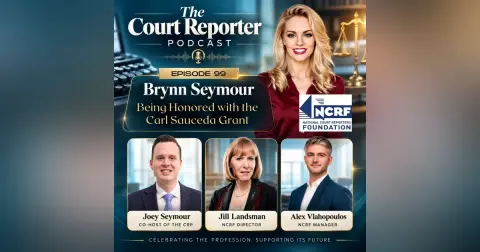


In this special episode of The Court Reporter Podcast, Joey Seymour steps behind the microphone as guest host for a conversation with Jill Parker Landsman and Alex Vlahopoulos of the National Court Reporters Foundation (NCRF).
The conversation gets personal as Jill and Alex share why I, as the host of the Court Reporter Podcast, was unanimously selected as the 2026 recipient! I am truly honored and encouraged by this, so I wrote a song about it... I hope you love it! I'm so excited to continue giving back to the profession. They dive deep into the impact The Court Reporter Podcast has had inside and even beyond the U.S., and why this grant is about much more than receiving an award. I am so grateful to receive this nomination, and I have so many people to thank for supporting along the journey. Keep showing up!
In this episode:
- The story and legacy of Carl Sauceda
- Why the grant was created in his honor
- What makes someone an ambassador for court reporting
- Why the grant continues to create a ripple effect years after someone receives it
- Why Brynn was unanimously selected as the 2026 recipient
- The role social media, mentorship, education, and outreach can play in advancing the profession, and why that matters (discussing the nationwide shortage)
- How to nominate a deserving reporter or captioner for a future Carl Sauceda Grant
- Jill's advice for students and working reporters: never stop practicing
- Why technical skill alone isn't enough — and why freelance reporters also need strong business skills
Most importantly, this conversation is an invitation to consider the impact each of us can have on the profession.
You don't need a title, a huge platform, or decades in the field to give back. Mentor someone. Encourage a student. Introduce someone to stenography. Share what you've learned. Create something that helps the reporter coming behind you.
Keep showing up — because you may never know how far that impact will travel.
When the membership sees who wins, it's going to spark ideas, and it's going to be an inspiration to other court reporters to do something comparable.
Speaker BKeep showing up, keep giving what you got.
Speaker BKeep believing in the work, even when nobody stops.
Speaker ABryn was unanimously decided on because of her podcast, and she exemplifies what the embodiment of this grant of being an ambassador for court reporting.
Speaker BWe'll keep giving what we've got.
Speaker BWe'll keep believing in the work, getting each other through it all.
Speaker BWe'll tell somebody we see, we'll remind them why they came, and we'll leave this place much stronger than the way we found it yesterday.
Speaker CI mean, one thing that stood out to me, if I may, was Bryn was recommended by Justine Aragones from the Philippines.
Speaker CSo when I saw that, I thought I was like, well, I mean, clearly there's people from all over the world who are tuning into this podcast.
Speaker DOkay, so today's episode is a little bit different because it's not hosted by me.
Speaker DWe have a guest host today because, surprise, I was in a deposition, wasn't I?
Speaker EI think so.
Speaker DSo today's episode is hosted by my husband, Joey Seymour.
Speaker DWelcome to the core reporter podcast, Joey.
Speaker EThank you.
Speaker DTell us about this episode.
Speaker DWhat can we expect?
Speaker EWell, this episode is a very special episode because Bryn and I, we just recently returned from NCRA conference, and during the conference, Bryn was awarded with the Carl Sauceda Grant.
Speaker EThis is a really prestigious award that has been given to court reporters over the past five, I think maybe not five, but four years at least, for their contributions to helping educate others on their career path to becoming court reporters.
Speaker ESo this year, Bryn was recognized with this grant.
Speaker EIn this episode, I had the pleasure of sitting down with Jill Lansman and Alex Vlahupoulos, and they explained a little bit more about the Carl Soceda Grant.
Speaker ESo it was really fun episode.
Speaker DI was very surprised and honored to have been nominated by someone that's not even in the United States for this award.
Speaker DJustine, my nominator.
Speaker DI can't wait to have a conversation with Justine on the podcast so that you can all meet.
Speaker DSo I'm really excited because I have not even gotten to listen to this episode yet.
Speaker DWhat was the highlight of it for you?
Speaker DWas it about TikTok?
Speaker DBecause I heard that in the highlights.
Speaker FNo, that.
Speaker FThat wasn't.
Speaker EI mean, that was a cool part of it.
Speaker EI remember you interviewed someone who went viral on TikTok.
Speaker DYeah, Vanessa sharing this venom machine.
Speaker DI saw her at the convention and I didn't get to Say hi.
Speaker DAnd I also saw Mark Kislingberry, and I wanted to say hi to them.
Speaker DShout out to Mark Kislingberry and Vanessa Stanton.
Speaker DWhat were you saying about Vanessa that you talked about that?
Speaker EWell, I don't remember who.
Speaker EI guess it was Vanessa who showed.
Speaker EShe made some videos on TikTok and showed her stenum machine.
Speaker DLike she just went viral by accident.
Speaker DIt was.
Speaker DYeah, it's just like court reporting is such a fascinating thing for a lot of people.
Speaker DThey've never seen the machine before.
Speaker DThey don't know how people can type so fast is just really fascinating for everybody.
Speaker EI think what the highlight for me was, it was the fact that the Court Reporter podcast has gotten so much attention, and that's what really played a big part in you getting nominated and winning the Carl Sauceda grant.
Speaker ESo that was my favorite part because it just goes to show how this idea really grew into something amazing that's really affected so many different people in court reporting and how now you're.
Speaker EYou're seeing the fruit of your labors.
Speaker DWell, I can't wait to hear more and learn more about the origin of this award and who Carl Sauceda is and what kind of a legacy he built.
Speaker DSo should we get right into it?
Speaker EYeah, let's get into it.
Speaker FToday in the Court Reporter podcast, we're joined by Joe Landsman and Alex Vlahupalos.
Speaker FDid I say it correctly?
Speaker CAlmost.
Speaker CIt's Vlahopoulos.
Speaker FOkay.
Speaker FI had a feeling.
Speaker FI was kind of altering the vowels there, but I was like, let me.
Speaker FLet me get it a shot and see what happens.
Speaker FHappens.
Speaker FJill, you could start by just introducing yourself and letting listeners know what your role is with the ncrf.
Speaker AWell, thank you very much, Joey, for this invitation.
Speaker AWe're delighted to be here today.
Speaker AI was hired in 2019 to be the manager of the National Court Reporters Foundation.
Speaker AI was interested in the position because I love philanthropy, I love giving back, and I had lots of experience with nonprofits in the DMV area, which is Washington, dc, Maryland and Virginia.
Speaker AWe believe in helping court reporters from recruitment to retirement, and we come up with excellent programs, scholarships, and grants along the way to make sure that they benefit, they become engaged, and they have opportunities for growth and learning.
Speaker ASo it's just been a joy to work with all these court reporters, I must say.
Speaker FWe're also joined by Alex.
Speaker FPerhaps you could give just a brief intro about yourself as well.
Speaker CYeah, sure.
Speaker CSo my name is Alex Vahopoulos.
Speaker CI had a work background in sort of educational, nonprofit work and also fundraising.
Speaker CBut more on the political side of things, and also just sort of outreach to, you know, donors and that sort of line of work.
Speaker CAnd I was kind of getting tired a little bit of that world, and I found a job posting for a position as manager at ncrf, the National Court Reporters Foundation.
Speaker CI put in an application, and Jill called me, and I've been working here for just about a year now, so.
Speaker CAnd it's been really nice to learn more about the world of court reporting and sonography and captioning, something that I was vaguely aware about.
Speaker CYou know, I knew what a court reporter and a stenographer were in theory, but I've gotten to know a lot more about the practical side of the industry.
Speaker CSo that's been really nice.
Speaker FI think a lot of us somehow fall into this industry.
Speaker FNot intentionally, one way or another.
Speaker FSomehow we get involved.
Speaker FRight.
Speaker FSame thing for me.
Speaker FI mean, I kind of vaguely knew what court reporting was, and it was only through my wife, Bryn, that I was able to actually get really introduced to the world of court reporting and then attending these different events and conventions and whatnot and really see the incredible world of stenography.
Speaker FIt's pretty cool how we kind of all come from, like, different paths and things like that.
Speaker FMy background was actually in journalism, so I saw, Jill, that your background was also in journalism.
Speaker AIt is.
Speaker FWe have curious minds, and I think there's a lot of curiosity when it comes to court reporting.
Speaker FSo it's kind of cool how we all ended up in this industry.
Speaker FSo, of course, we wanted to discuss the Carl Sauce Data Grant.
Speaker FAnd for those who may not be aware, this year Bryn was awarded with the Carl Salceda Grant for her efforts to elevate the profession by teaching others and mentoring and sharing her knowledge, especially through this platform, the Port Reporter Podcast.
Speaker FI think it would only be right to discuss the origin of this grant, being that it's named after Carl Saseda.
Speaker FHe was the NCRA president from 1999 to 2000, and that he was just very passionate about teaching his peers and elevating other court reporters, and that he just.
Speaker FHe would have a big smile seeing them advance in their careers.
Speaker FHow did this grant.
Speaker FWhat led to his creation?
Speaker AWho.
Speaker AI'm happy to explain that to you.
Speaker ASo in 2021, we had a little bit of movement on the trustees of the foundation, and early Langley became our chair.
Speaker AAnd she appointed Linda McSwain to replace the trustee.
Speaker AAnd she shared with us that her friends and colleagues in the African American court reporters decided to fund the Carl Ceseda grant.
Speaker AAnd they were sharing that they wanted it to be launched on Monday, the Monday of Martin Luther King Day.
Speaker AAnd it was a logical day for us to open up the grant.
Speaker ANow, there was a lot of discussion back then between the trustees and Linda to determine whether this was going to be a private or a public grant.
Speaker APublic meaning to our membership and forever.
Speaker AThat is what we ultimately decided to do, offer it to everybody.
Speaker AAny court reporter or captioner who is an ambassador for this business would be a prospective nominee.
Speaker ASo we decided to create the grant in 2021.
Speaker AIt was offered in 2022 for the first time, opening on Martin Luther King Day of Service.
Speaker AAnd we promote it with a marketing plan.
Speaker AAnd that includes an article in the JCR tile ads for social media and advance articles on the jcr.com the very first recipient was Marguerite Rogers, who had created multiple events to promote court reporting, not the least of which was going into public schools on career days and bringing in her writer and letting all the students touch the machine and learn about it, many of which were at her own expense.
Speaker AAnd so the backstory of this grant was to sort of reimburse the ambassadors with the expenses that they lay out to try and promote the school court reporting profession and card captioning profession.
Speaker AAnd then the next year, we had lots of applicants, and the committee that decided on who would win picked three winners.
Speaker AThere was Erminia Uviedo, Stacy Drahovski, and Kimberly Xavier.
Speaker AThen after that, we had Denis Vidal from New Jersey who won the award, and Chris Degrazio from Florida won it in 2025.
Speaker AAnd then this past year, we have Brynn.
Speaker ABryn was unanimously decided on because of her podcast, and she exemplifies what the embodiment of this grant of being an ambassador for court reporting.
Speaker ASo we're very proud of the history of our winners and the work that they have done.
Speaker AAnd I personally consider it one of my favorite grants because of the sharing that goes on and the outreach that is accomplished by our nominees.
Speaker AAnd we're very proud of Bryn and the work that she has done.
Speaker AAnd it was unanimous that she be selected.
Speaker AAnd the nomination was very impressive, I must say.
Speaker FIt seems like it really embodies selflessness in this industry and really giving out to others.
Speaker FAnd I was reading about Mary Rogers and how she won the first, you know, inaugural Carl Salceder Grant, and it seems like it aligned very well with what she was doing.
Speaker FShe wanted to write the I have a dream speech on her machine and then have others do it together with her and each write a different portion.
Speaker FWhat better inaugural recipient to kick it off when it's the kickoff is Martin Luther or King Day that year.
Speaker FRight?
Speaker AExactly.
Speaker ASo if anybody wanted that booklet, they would have to buy for $25.
Speaker AAnd that $25 went to the Cross Aseda Grant.
Speaker AAnd Kimberly Xavier, who is from Arlington, Texas, did a special event in Texas.
Speaker AAnd all of the profit from the event went to the Cross SOCA grant, too.
Speaker AWe have several donors on our gibbsmart fundraising platform who donate just to that grant, which is called a restricted grant.
Speaker AAnd when we were in Bellevue, Washington, at our conference, somebody came up to the booth who said she knew Carl very well and she was making a donation for his grant.
Speaker ASo it's very well received as a very special grant.
Speaker FAnd so would you say that as you mentioned before, this grant was mainly created because of the fact that I think you said the Altruism grant, you have to be a court reporter for 25 years, which is a tall task.
Speaker FRight.
Speaker FAnd a lot of court reporters maybe have not reached that pinnacle yet.
Speaker FWas that the main reason this was created to kind of compensate for that or not at all?
Speaker ANo.
Speaker FOkay.
Speaker AThis because this was considered an ambassadorship.
Speaker ALike you had to be a court reporter.
Speaker ACar captioner Ambassador.
Speaker AWhen the Altruism award is giving back, so you could give back to any nonprofit cause that you like, it doesn't have to just be court reporting.
Speaker AIt could be the Cancer Institute, it could be the Red Cross, it could be anything you want.
Speaker ABut you just have to be someone who gives back to the community.
Speaker AThis is industry specific.
Speaker FYeah, that makes a lot of sense.
Speaker FMore specific to the court reporting industry itself and giving back to fellow court reporters.
Speaker FIs there any anything that you hope that this grant will.
Speaker FAny kind of impact it will make on the future of court reporting or have you seen any impact so far within the court reporting community?
Speaker AI do think so.
Speaker AI think there's a lot of positive energy around it.
Speaker AI think there's a lot of prestige to it as well.
Speaker AAnd I think that when the membership sees who wins, that it's going to spark ideas and it's going to be an inspiration to other court reporters to do something comparable.
Speaker AAnd we're very grateful for that.
Speaker AAnd that inspiration sticks to this day.
Speaker AEvery single one of those winners has been a strong influencer to the court reporting community.
Speaker AIt's not a one and done thing at all.
Speaker AWhy doesn't Alex.
Speaker AAlex wrote the article about Brent.
Speaker AAlex, why don't you reflect on what you learned as you wrote the article announcing that Bryn won.
Speaker CI just was impressed by Bryn's commitment to sort of spreading the profession and the work that you and her have done in the podcast.
Speaker CI was kind of just.
Speaker CShe had quite a few very.
Speaker CI mean, extensive amount of positive recommendations written by, you know, leaders in the field and people who know her and I assume you very well.
Speaker CAnd when I was reading about, you know, Carl Ceseda's life and the challenges he faced and what he overcame and sort of how he developed into a very positive force and a leader in the field, I thought that, you know, Bryn really matched what we were looking for with Fat Grant.
Speaker CSo, you know, it was a pleasure, really, to judge her and write about the work you guys have been doing.
Speaker FThat's awesome to hear.
Speaker FA lot of listeners, they.
Speaker FThey share a lot of positive reviews of.
Speaker FOf the podcast because Bryn likes to touch on a lot of things that court don't learn about in school and a lot of things that they run into while as freelance court reporters, you're also a business owner in a sense, right?
Speaker FAnd you're trying to make your own business.
Speaker FAnd it's one thing to type on the machine.
Speaker FIt's a whole nother thing to get ready for tax season and go through all this paperwork and whatnot.
Speaker FThere's a lot of responsibility that court reporters have with their careers, so Bryn tries to really address those things.
Speaker FAnd even a lot of, like, newer court reporters, those who are just wrapping up their education, they've reached out, express their appreciation for some of the things that Bryn has discussed.
Speaker FSo it really is such an honor to be able to see Bryn receive this grant.
Speaker FIt came as a surprise to us because I don't think either of us were aware of this, being that it's recently new.
Speaker FRight.
Speaker FIt just started a couple of years ago, and I think Bren was really surprised and honored to receive this.
Speaker FSo we hope going forward that hopefully it can make a even more of an impact and encourage a lot of new reporters entering the industry as well.
Speaker CI mean, one thing that stood out to me, if I may, was Bryn was recommended by a woman named Justine Aragonis from the Philippines.
Speaker CSo when I saw that, I thought I was like, well, I mean, clearly there's people from all over the world who are, you know, tuning into this podcast.
Speaker CAnd we.
Speaker CI know Jill and I, we've had people from other countries attend our, you know, Ask Me Anything series and certain other programs that we put on.
Speaker CSo I just thought, you know, if her reach is already more global than Just sort of United States.
Speaker CI think that's.
Speaker CThat shows impact right there.
Speaker FYeah, that's.
Speaker FThat's incredible.
Speaker FI. I did not even know our reach was going to the Philippines.
Speaker FSo that's.
Speaker FThat's really encouraging to hear.
Speaker AThat is.
Speaker AAnd I know you're being modest since Bren is related to you, but this is a $2,000 grant every year, and as I mentioned before, one year we gave away three of them.
Speaker ABut we certainly hope that your podcast will be an inspiration to others to go out and be strong ambassadors for court reporting or card captioning, because we are definitely willing to recognize and honor those people.
Speaker AWe do have coverage articles about the winner.
Speaker AWe will be always wanting other ships to rise as they learn about what Brin has done and what our previous winners have done.
Speaker FI was just curious of some of the previous nominees and winners of examples of things that they've done as well.
Speaker FWould you be able to share any of that?
Speaker AEvery single winner was profiled with coverage articles on thejcr.com and we were able to dive deep into all of their qualifications to write those articles.
Speaker ABut I can tell you there's been a lot of educational outreach.
Speaker AVery often we will have these, quote, reporters go into schools on Career Day or host events or have nonprofits that help stenographers.
Speaker ASo right now, they've cast a very wide net on the activities that made them grant worthy.
Speaker ASo I recommend that any viewer of this podcast go to the jcr.com and put in Paul Ceseda grant, and all of those articles will be there to get the details of their winning outreach.
Speaker FOkay.
Speaker FFor the next coming year, if somebody would like to nominate a court reporter, how might they go about doing that?
Speaker AWe will have advance articles telling people to get ready for that.
Speaker ANominations open on Martin Luther King Day in January, and then it closes about eight to 10 weeks later.
Speaker AAnd we have an online application system with for the nominations through NCRA.org, but that information will be in our advance articles about it.
Speaker AAnd basically social media tiles will be out there on Facebook, Instagram, LinkedIn.
Speaker AWe do.
Speaker AWe do announce those on those social media platforms.
Speaker AWe used to have Tick Tock, but we don't anymore.
Speaker AI know Brynn's on TikTok, right?
Speaker FShe is.
Speaker FShe does have a big reach on TikTok as well.
Speaker FThe cool thing about TikTok is actually, obviously, it's a great way to reach the younger generation.
Speaker FGen z is on TikTok a lot.
Speaker FBut there's been some viral videos of actually court reporters on TikTok and people are just fascinated with the machine and sonography.
Speaker FSo it is a great way to actually do some outreach, I guess, and hopefully inspire people to get into court reporting as well.
Speaker FBut yeah, this is, this has been a pleasure speaking with you about the Carl Salceda Grant.
Speaker FBefore we kind of wrap things up, is there anything else that you'd like to mention about this grant?
Speaker ABasically, I, I just simply want to point out that lots of our winners have relied on social media for part of their outreach programs.
Speaker AThat's a hint or a clue of what other quote reporters might consider.
Speaker AAnd many of them do host in person events.
Speaker ASome of them are mentors and some of them are.
Speaker AThey're just very strong influencers and advocates about the cult reporting profession.
Speaker AThe very last tip that I have, and I say this to every time we interact with students and our scholarship winners, there is just no end to practicing.
Speaker AIt's like food, clothing, water and practice on your steno machine.
Speaker AMany of our strongest foundation leaders are so dedicated to practicing that they take their stent writers with them on vacation.
Speaker ASo I would simply say it's a skill that would go away, but as long as you keep practicing and you're keeping your eye on the prize.
Speaker AAnd as you mentioned, Joey, a lot of freelance court reporters have an opportunity to be highly successful with their own business.
Speaker AAnd it takes business management skills to be profitable.
Speaker ASo I really believe anyone can achieve that level of success.
Speaker ABut it doesn't happen by resting on your laurels.
Speaker AIt definitely takes discipline.
Speaker ASo we appreciate that future Cross Aseda Grant winners might be watching right now, and we hope that they are.
Speaker AAnd we congratulate Bryn on her big accomplishment for this very special grant since it is highly selective and isn't given just by writing an essay or having good academic scores.
Speaker AIt's.
Speaker AIt's an accomplishment based grant.
Speaker AAnd our hat goes off to every single winner.
Speaker AAnd we appreciate the opportunity you gave us today to talk about it.
Speaker FOur hat goes off to everyone who won the grant, including Bryn this year.
Speaker FAnd it's really something to celebrate.
Speaker FAnd like you said, I know court reporting, obviously there's a skill to it, but like you said, it takes a lot of hard work and trust me, I see Bryn working extra hours doing her scoping and proofreading and a lot goes into it, but obviously there's a reward on the other end of it.
Speaker FSo it is really inspiring.
Speaker FSo, yeah, thank you so much for joining us, Jill and Alex, for sharing more about the Carl Sauce Data grant.
Speaker FAnd I hope the listeners who are listening, maybe you were not aware of this grant.
Speaker FNow you know about it.
Speaker FAnd you can also nominate anyone next year that you think is worthy of this grant.
Speaker FAnd then if anyone has any questions or they want to learn more, would you say go to the same website,.
Speaker AJcr.com well, the jcr.com is our online magazine.
Speaker AOur main website is ncra.org and to reach the foundation pages it is ncra.org foundation and then.
Speaker AOr you could just put grants in the search bar and you'll find our Carlseda grant there as well.
Speaker AWe have other grants, but all of our grants will pop up on our grants page.
Speaker AWe are always making new offerings as well because we are growing by leaps and bounds.
Speaker AWe have more angel donors than ever before and that gives us a chance to give back more.
Speaker FThat's amazing.
Speaker FWell, thank you so much for joining us and everyone.
Speaker FI hope you took away a lot from this and we'll see you next time in the Court Reporter podcast.
Speaker BYou don't always know who's listening when you speak into the quiet you don't always see the difference when you're somewhere, somewhere in the middle of trying A student finds a little courage Someone stays another day.
Speaker BA voice reminds a room of people why they chose this anyway?
Speaker BMaybe we don't need to know how far the smallest kindness go.
Speaker BSo keep showing up, keep giving what you got Keep believing in the work Even when nobody stops to tell you that they noticed or the difference that you made Cause somewhere down the road the light you get comes back your way Keep showing up, keep showing up it's the messages after midnight it's the answer no one sees it's believing somebody when they're struggling to believe it's the hours that aren't counted and the things you freely give it's leaving something better for the ones who come up next.
Speaker BYou may never see see it all but every little ripple travels on so keep showing up keep giving what you got Keep believing in the word Even when nobody stops to tell you that they noticed all the difference that you made Cause somewhere down the road all the love you gave comes back your way Keep showing up, keep showing up.
Speaker BThis isn't about a name or something hey hanging on a wall it's knowing what you gave away Mind something after all if one voice can list another Imagine what we do when a whole profession turns around and says we believe in you.
Speaker BSo we'll keep showing up we'll keep giving what we've got we'll keep believing been in the work and in each other through it all we'll tell somebody we see we'll remind them why they came and we'll leave this place Much stronger Than the way we found it yesterday we'll keep showing up yeah, we'll keep showing up for the ones who came before us for the one still on their way for every voice that lives together we'll keep showing up.


